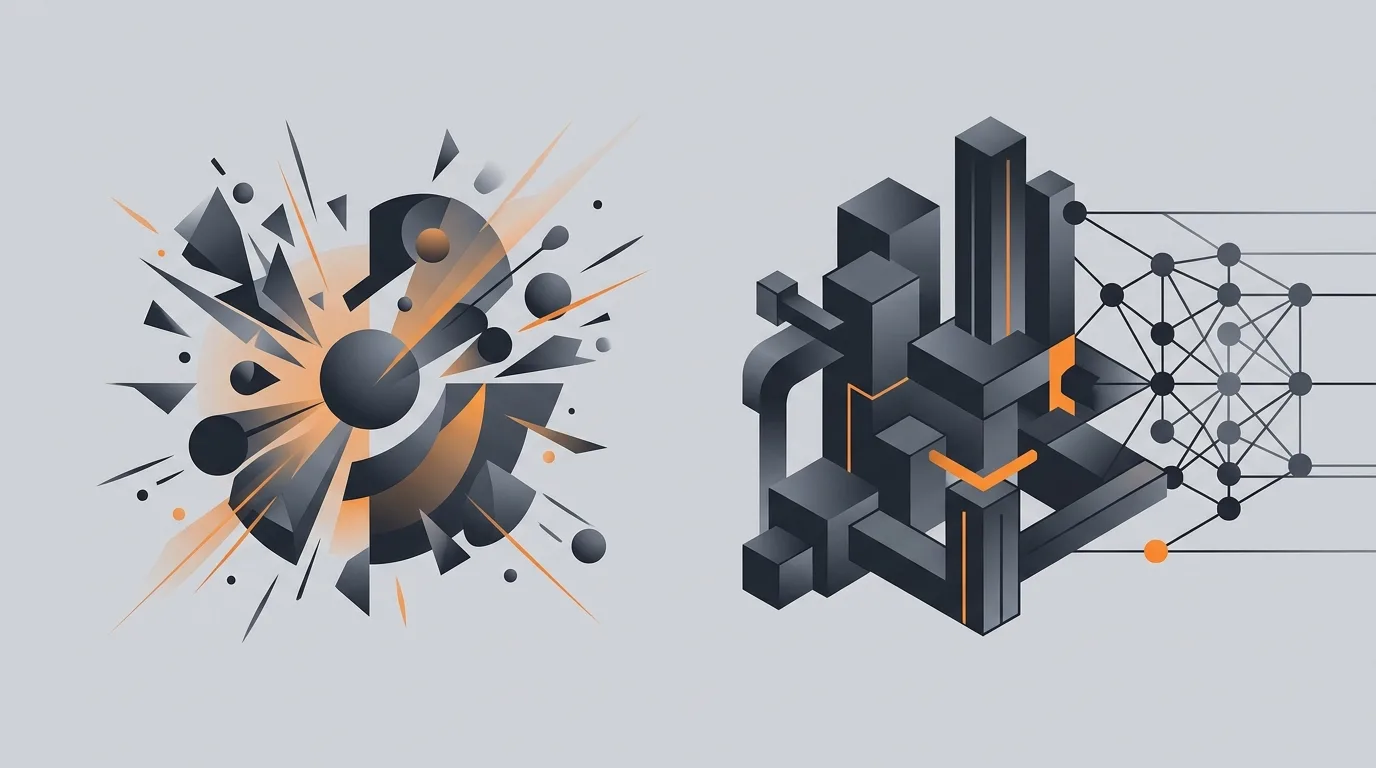
In March 2025, Manus put out a demo that did the thing every agent vendor had been promising for a year. It opened a browser, hunted down a property listing, compared it to ten others, drafted an analysis, and emailed it to the user. The video circulated on X, racked up tens of millions of views, and convinced a lot of buyers that the agent era had arrived. Eight weeks later, several of those same buyers tried to deploy Manus into daily ops and discovered the gap between a demo and a deploy.
This is not a Manus pile-on. The team at Butterfly Effect shipped real capability and pushed the field forward. It is a category-distinction piece. Manus and Gravity are both autonomous agents, but they are aiming at different surfaces. One is built to impress; the other is built to keep running.
What Manus did to the agent conversation in 2025
Manus launched publicly in March 2025 by Butterfly Effect, a Chinese AI startup. The launch video showed an agent autonomously planning, browsing, executing computer-use actions, and producing a complete deliverable. The video spread across X and Chinese platforms; within days the official Manus Discord passed 138,000 members and invite codes were reselling for thousands of dollars on the Chinese reseller app Xianyu (TechCrunch, March 2025). Within a month, every major newsletter was running pieces on "the Chinese AI agent that broke through" and Western VCs were quietly asking each other whether they had missed the cycle.
The product had a real underlying capability. Long-context planning, computer-use actions, sandboxed execution, deliverable generation. It was not a fake. It was, however, optimised for the demo surface: a one-off task, watched live, with the wow-factor being the autonomy itself. The deploy surface (recurring tasks, monitored, reliable for months) was a different conversation.
What Manus actually is (architecturally)
Architecturally, Manus is a multi-step agentic system on top of a frontier model (the company has been deliberately vague about which models it routes to). It exposes a chat interface where the user describes a task. The agent then runs in a sandboxed virtual environment with browser access, file operations, and code execution. Outputs are produced as artifacts the user can review.
The sandboxed VM
Each task runs inside a managed VM. This is the architecture that makes the demos visually compelling: you watch a browser open, scroll, click, type, all driven by the model's decisions. It is also the architecture that makes reliability hard at scale: VMs leak state, websites change, login flows drift, and the same task that worked yesterday breaks today.
The long-context planner
The planner holds the user's intent and tracks subgoals across hundreds of steps. This is impressive at first glance and challenging in practice; long-context planning tends to drift, repeat actions, or miss task boundaries. According to a 2024 evaluation by independent agent benchmarks like AgentBench and OSWorld, frontier agents typically achieve 30-50% success on long-horizon real-world tasks, with substantial variance run-over-run (AgentBench paper, 2023).
What Gravity does differently
Gravity invests heavily in the boring half of agents: testing, recovery, monitoring, integrations, predictable cost. Every capability gets 80+ scenario tests before it ships to a buyer (see how we test AI agents). Each agent is deployed for recurring work and lives inside a runtime with retries, backoff, escalation, and audit logs.
The deliberate trade-off: Gravity gives up some demo magic for operations reliability. You will not watch a Gravity agent doing a 12-step research task live on screen. You will get a result every day at 9am that you can trust without watching. For the deeper version of this bet see describe outcome, not workflow, three startups, three shutdowns, and AI agent failure modes.
Demo-grade vs operations-grade: the framework
Two columns, six rows. This is the lens for looking at any agent product in 2026.
| Dimension | Demo-grade | Operations-grade |
|---|---|---|
| Optimised for | Wow factor in one run | Reliability over months |
| Reliability standard | Works in the recording | P95 success ≥ stated bar |
| Cost model | Variable, sometimes runaway | Predictable, capped per task |
| Failure handling | Try again, sometimes | Tested recovery paths |
| Monitoring | Watch live | Dashboard, alerts, audit |
| Test depth | Few scenarios in dev | 80+ scenarios before ship |
Most products in 2026 sit somewhere on the spectrum. Manus is closer to the demo end. Gravity is built explicitly toward the operations end. Neither is wrong; they answer different buyer questions.
Reliability comparison: where Manus has known failure modes
Three reliability patterns have been reported in independent reviews of Manus through 2025-2026 (consolidated from Reddit threads in r/singularity, blog reviews by independent AI researchers, and public discussions on X).
Long-task drift
On tasks spanning more than 30-50 steps, the planner starts to lose the original goal. The agent ends up doing something adjacent but wrong. This is consistent with frontier model behaviour on long-horizon tasks and not unique to Manus, but the product surface exposes it because users start tasks they expect to take hours.
Cost surprises
Without a hard cap, a Manus task can rack up significant tokens before the user realises. The "I went to bed and woke up to a 40-dollar bill" pattern. Operations-grade platforms ship with per-task budget ceilings and circuit-breakers.
Hosting and data residency
Butterfly Effect is a Chinese company and the primary infrastructure historically sits inside China. For US and EU buyers with GDPR, SOC2, HIPAA, or government-related procurement, this is a procurement issue regardless of the capability. Some region-specific hosting has been added through 2025-2026, but the burden is on the buyer to verify the current posture.
Where Manus is the right tool
Three categories where Manus is the better choice over Gravity.
Exploratory research
"Find me everything notable about company X in the last 60 days" is a research task that benefits from Manus's autonomy. The output is a one-off artifact. You read it, you use it, you move on. Reliability variance is acceptable because you are reading the output anyway.
One-off prototyping
"Try to automate this gnarly thing for me by Friday." A founder or solo operator can use Manus as an exploratory tool to see whether the task is automatable at all. Once the answer is yes, productionising it belongs in an operations-grade platform.
Computer-use experiments
If your specific task is "drive this niche SaaS web app that has no API", Manus's computer-use surface is genuinely useful. The demo magic and the actual capability overlap here.
Where Gravity wins
Three opposite categories.
Recurring operations
"Greet every new customer, follow up cold leads weekly, reconcile invoices Monday morning" is operations work. It runs every day for years. Variance kills it. Gravity invests in the runtime that makes recurring work reliable. See AI agent vs chatbot vs assistant for the category framing.
Regulated data
Healthcare, finance, legal, and other regulated industries cannot ship sensitive data to opaque hosting profiles. Operations-grade platforms commit to data residency, audit logs, and compliance posture. Demo-grade platforms typically have not invested there yet.
Predictability over impressiveness
The buyer who wants a result they can trust at 9am every day is buying predictability. The buyer who wants to see the agent work is buying impressiveness. These are different sales and different products. Gravity is built for the first buyer.
Frequently asked questions
What is Manus and who built it?
Manus is an autonomous agent product from Butterfly Effect, a Chinese AI startup. It launched in March 2025 and went viral on social media for demos that showed an agent autonomously browsing, executing tasks in a sandboxed computer, and producing deliverables. Its strength is exploratory, one-off, computer-use tasks; its weakness is reliability under repeat operations.
Is Manus reliable enough for daily ops work?
Independent reviewers in 2025 reported high variance in Manus reliability: long-running tasks would drift, occasional infinite loops in browsing, and unpredictable cost. The product is excellent for one-off exploratory work and uneven for daily recurring ops. The gap is testing depth and recovery, which is what an operations-grade platform invests in.
What is the difference between demo-grade and operations-grade agents?
Demo-grade means the agent can do the impressive thing once on camera. Operations-grade means the agent does the same thing reliably every day for months. The investments are different: demos optimise breadth of capability; operations optimise tested recovery, cost predictability, monitoring, and integrations. Most agent products in 2026 are demo-grade. The market has not yet rewarded operations-grade.
Where is Manus hosted and is that a concern?
Manus is operated from infrastructure based in China by Butterfly Effect. For US and EU buyers with data-residency requirements (GDPR, SOC2, HIPAA), that hosting profile is a procurement issue. The capability is impressive; the procurement story is challenging. Some Manus features have offered region-specific hosting in 2025-2026, but buyers should verify the current state before standardising on it.
When should I use Manus versus Gravity?
Use Manus for exploratory tasks, one-off research, computer-use experiments, and demos. Use Gravity for recurring ops, integrations with your SaaS stack, regulated data, and any task that has to run reliably every day. The split is once-and-watch versus deployed-and-trust.
Three takeaways before you close this tab
- Manus is a demo-grade agent. Excellent at impressing; less invested in repeat reliability.
- Gravity is an operations-grade agent. Optimised for the boring half: testing, recovery, predictability, integrations.
- The unit of work decides the fit. Once-and-watch tasks fit Manus. Deployed-and-trust tasks fit Gravity.
Sources
- TechCrunch, "Manus probably isn't China's second DeepSeek moment", 9 March 2025, techcrunch.com
- Butterfly Effect / Manus, "Product page", retrieved 2026-05-14, manus.im
- AgentBench, "Evaluating LLMs as Agents", 2023, arxiv.org/abs/2308.03688
- OSWorld benchmark, "Computer-use agent evaluation", 2024, os-world.github.io
- Anthropic, "Building Effective Agents", retrieved 2026-05-14, anthropic.com
- Gravity, "How we test AI agents", May 2026, how we test AI agents