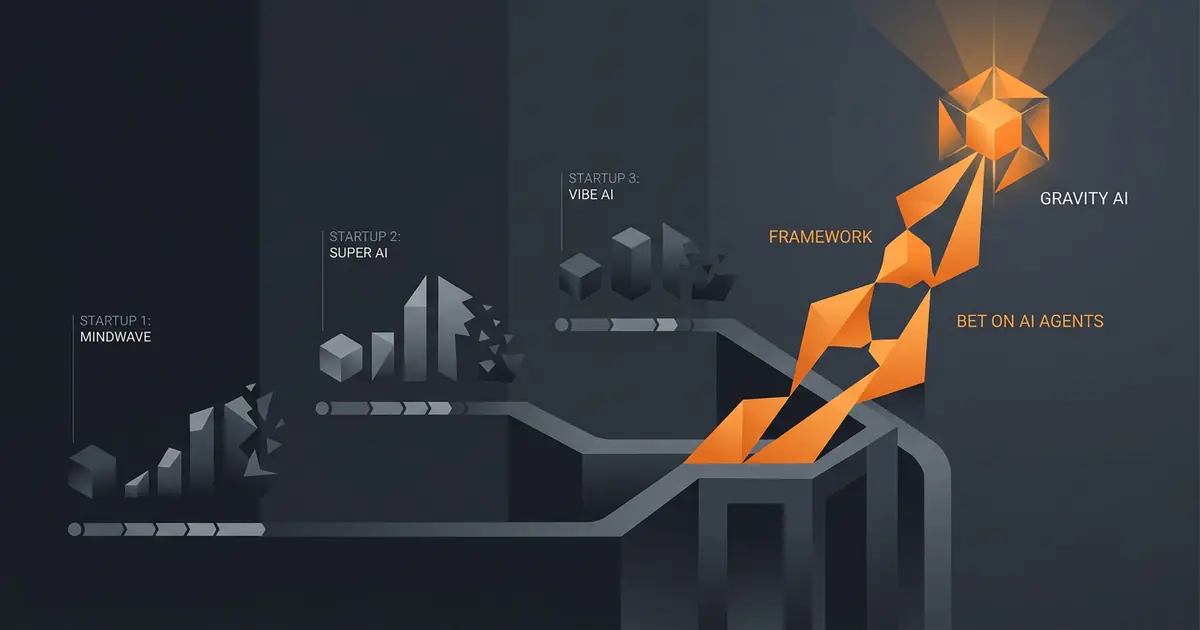
In early 2026, 40% of AI startups launched in 2024 had already shut down (TechStartups, AI shutdowns roundup, December 2025). I'd already been in three of those statistics, just a year or two earlier than the cohort. From October 2022 to February 2026, I shipped and shut down three startups: MindWave (mental health), Super AI (an all-in-one AI platform), and Vibe AI (an AI friend). All three are dead. Gravity is bet four.
This is the framework that emerged. Not because I read it in a book, because three failures forced it on me. Each one died of a different missing check, and the absence of any single one was sufficient. If you're mid-build, you can run this pre-mortem instead of the postmortem.
Postmortem #1,MindWave: the mental health platform that couldn't survive its own honesty
From October 2022 to October 2023, I built MindWave out of Pune,a mental health app focused on private sharing, support, journaling, and venting. The thesis: the existing apps treated mental health like a meditation playlist, and the users I cared about needed something more direct. We were also working on group therapy and a free professional community as the next layer.
It worked, in the sense that real people showed up and used it for real things. People shared. People came back. The pieces of the product that shipped did the job they were supposed to do. What it didn't do was clear an obvious bar against the alternatives. BetterHelp, Wysa, Calm, none of them were exactly what we were building, but the user's question wasn't "is this exactly right?" It was "is this so much better than what I already use that I'll switch?"
The honest answer was no. Not in a way that mattered.
I shut MindWave down a year in. The triggering moment wasn't a single bad metric, it was the realization that every time I described the product to someone new, I was selling on care and warmth, not on a measurable improvement. "It's gentler than the alternatives" is a feature; it's not a category-shifter. Two years later, Yara AI ran a related thesis, an AI mental health companion, and shut down in November 2025 because the founders concluded that AI chat for serious mental health was too dangerous (Fortune, November 2025). Different reason for shutdown. Same underlying problem: in this category, "better" has a much higher bar than usual.
Lesson tagged: massive-value test failed. The product was useful. It wasn't 10x. Peter Thiel's Zero to One argues that anything less than a 10x improvement gets perceived as marginal and dies in crowded markets (Volt Equity, summary of Zero to One). I learned this the hard way.
Postmortem #2,Super AI and the all-in-one trap
From March 2024 to March 2025, I built Super AI,an all-in-one AI platform that picked the right model for each task automatically. The 2024 thesis was simple: foundation models were getting better fast, picking the right one was annoying, and a router that did it for you was real value. I did the GrowthX Capstone in October 2024 partly to pressure-test exactly this thesis.
The thesis aged badly. By late 2024 the foundation models were converging, GPT-4-class quality became the floor, not the ceiling. The "right model for the right task" routing problem started to flatten. By the time ChatGPT Workspace Agents launched in April 2026, the all-in-one category was structurally obsolete. Super AI didn't make it that long; I shut it down in March 2025.
I wasn't alone. Builder.ai, the Microsoft-backed all-in-one AI startup once valued at $1.2 billion, declared bankruptcy in May 2025 (TechStartups, AI shutdowns roundup, December 2025). Different scale. Same structural failure. All-in-one means no specific user wins big enough to remember you, and once the underlying thing you wrap commoditizes, the wrap has no margin to defend.
Lesson tagged: scaling-potential test failed. Super AI's TAM didn't expand with success. Each new user just routed to one of the same models. The kind of growth that opens new jobs, what aggregator-style products almost never get, wasn't there. Specific products that solve one user's problem 10x better beat horizontal aggregators in commoditized markets.
Postmortem #3,Vibe AI and the friend that wasn't
From March 2025 to February 2026, I built Vibe AI,an AI friend. The thesis: people are lonelier than they admit, and a thoughtful AI companion is more useful than another productivity tool. Some of that was right. Engagement in week one was real. People sent long messages. They came back the next morning.
Then week three happened. The novelty curve crashed into the cost curve. Compute for long contextual conversations isn't free, and the price the audience would pay for an AI friend was much lower than the price the conversations cost to run. The 30-day retention curve and the cost-per-active-user curve crossed before we ever found a paid model that worked. I shut it down in February 2026.
The AI companion category was the deadliest vertical of 2025 (TechStartups) for exactly this reason. As the broader category data showed in 2026, OpenAI's Sora burned an estimated $15 million per day in compute against $2.1 million in lifetime revenue, different scale, same shape (Digital Applied, AI product failures 2026, accessed 2026-05-05). When per-user economics are negative, growth deepens losses; the math doesn't fix itself with scale.
Lesson tagged: sustainable-margins test failed. The product was loved. It wasn't a business. Two distinct things.
The framework, three checks every startup must pass
Three failures isn't a streak. It's data. Each shutdown traced to a different missing check, and the absence of any one was sufficient cause of death. The framework isn't novel, versions of it live in Zero to One, in CB Insights' postmortem corpus, in Wilbur Labs' founder survey of 200 entrepreneurs (Wilbur Labs, Why Startups Fail, 2026). What's rare is having to assemble it from your own failures.
Check 1,10x value
Peter Thiel: "Proprietary technology must be at least 10 times better than its closest substitute" (Zero to One, summarised by Volt Equity). Marginal improvements get marginal results. MindWave failed this check.
Check 2,Scaling potential
Not user growth, TAM expansion. Does success mean more of the same job, or does it open new jobs? Aggregator products fail this check by design. Super AI failed this one.
Check 3,Sustainable margins
Unit economics positive without subsidy. If a free-tier user costs more in compute than a paid user pays in revenue, growth deepens losses. In 2026, this kills more AI products than any other failure mode. Vibe AI failed this one.
The three checks are an AND, not an OR. Two-out-of-three is still dead. MindWave had scaling potential and decent margins; missing the 10x killed it. Super AI had 10x speed and decent margins; missing scaling killed it. Vibe AI had 10x emotional value and scaling; missing margins killed it. None of the three required heroic execution, they required the right premise. That's the test.
Why workflow tools were the wrong abstraction
Halfway through Vibe AI, I started noticing a different problem. It wasn't about any one product I'd shipped. It was about the abstraction the whole industry inherited from the 2010s: the workflow. Trigger → step → action. Zapier built a $5B business on it. n8n, Make, Pipedream, Activepieces, all variations on the same mental model.
The model has a fatal assumption: the user is willing to think like a programmer. Most operators aren't. When the underlying intelligence got smart enough to figure out the steps on its own, the workflow editor became the only bottleneck. The thing slowing AI adoption wasn't the model; it was the requirement to design the path.
That conviction shaped Gravity. Describe the outcome, let the agent figure out the sequence, retries, and exceptions. [INTERNAL-LINK: the case against Zapier-style automation → /blog/describe-outcome-not-workflow/] covers the full argument; this section is the short version. If your tool requires the user to think like a programmer, you've narrowed your TAM to programmers. Most operators aren't.
Why Gravity passes all three checks on day one
Bet four is the first one where, on my honest read, all three lights are green before launch. Honest is doing a lot of work in that sentence,I've been wrong three times. Here's the accounting against each check.
10x value: 60-second deploy time vs. days-to-weeks for every competitor in the comparison set. Specific number, specific dimension. The 60-second deploy is measured from natural-language prompt to a running agent, not from "agent finished thinking" to "agent ready to be wired up". If you've used Lindy, n8n, or any agent framework, you know which kind of measurement actually matters.
Scaling potential: TAM is every recurring task in every knowledge worker's day. Inbox triage opens email. Lead follow-up opens sales. Competitor tracking opens marketing. Each new vertical opens a new job class, not a deeper version of the same one. That's the structural difference between a product and an aggregator: products grow by entering new categories of work.
Sustainable margins: Capability-based pricing with positive per-active-agent margin at scale. The structural choice: charge for capability (the agent's ongoing job), not per-task (which subsidizes the heaviest users at the lightest users' expense). The math is simpler and the per-user economics work.
Here's the honest hedge. The framework is necessary, not sufficient. Bet four can still die. The 80%+ of failed founders who launch another company (Wilbur Labs) didn't all succeed on attempt two. CB Insights' 2026 corpus shows that 70% of failed startups ran out of capital, but the underlying causes were PMF (43%), timing (29%), and unit economics (19%) (CB Insights). The framework rules out PMF and unit-economics failures structurally. Timing it can't fix.
What I'd tell my younger self (and any founder mid-build)
Three things. None of them surprising. All of them expensive when learned the slow way.
- Run the three checks before you commit, not after. Most founders run them implicitly during the postmortem. They're cheaper to run as a pre-mortem. If you can't honestly green-light all three before raising the seed round, you have a problem you're not pricing in.
- Treat "we're early" as a flag, not a defense. Early can mean "before the wave" or "before the wave decides not to come". Yara AI was early. So was Vibe AI. So was Builder.ai. The market doesn't reward early; it rewards right-sized for the wave that actually arrives.
- The framework is necessary AND insufficient. Three green lights don't guarantee a hit. They prevent specific failure modes. Execution still kills. But you'd rather die from execution failures than from framework ones, those are at least learnable.
If any of this resonates, either you're building right now, or you're evaluating products built by founders like me,I read every email at aryan@gravity.fast. The About page has the company background, and if you want to know what Gravity actually does, the homepage's how-it-works section is the shortest path.
Frequently asked questions
Why do AI startups fail?
CB Insights' 2026 analysis of 431 failed VC-backed startups found capital exhaustion as the surface cause for 70%,but the underlying drivers were poor product-market fit (43%), bad timing (29%), and unsustainable unit economics (19%). My own three shutdowns map cleanly to those three failure modes.
What is the 10x rule for startups?
Peter Thiel's 10x rule from Zero to One holds that a new product must be at least 10 times better than its closest substitute on at least one dimension to escape competition. Anything less is perceived as marginal and gets crushed by incumbents in crowded markets.
How long did each of your prior startups run?
MindWave (mental health, founded in Pune) ran October 2022 to October 2023,about 13 months. Super AI ran March 2024 to March 2025, also 13 months. Vibe AI ran March 2025 to February 2026, almost exactly one year. Three attempts, three years, before Gravity launched in February 2026.
What's structurally different about Gravity vs your previous attempts?
Gravity is the first one where, on my honest read, all three checks pass on day one: a 10x speed advantage (60-second deploy versus days or weeks for competitors), TAM expansion (every recurring task in every knowledge worker's day is a different agent), and capability-based pricing with positive per-agent margin at scale.
Should I keep building if my first startup failed?
Wilbur Labs' 2026 survey of 200 founders found that more than 80% of those who'd been through a failure said the experience made them more likely to launch again, not less. Failure compounds into clarity, but only if you postmortem honestly enough to extract the framework that prevents the next one.
Three takeaways before you close this tab
- Run the three checks pre-mortem. 10x value × scaling potential × sustainable margins. All three required.
- The surface cause is rarely the real cause. Running out of capital is what death looks like. PMF, timing, and unit economics are what killed you twelve months earlier.
- Failure is data, not identity. 80% of failed founders try again. The ones who succeed on attempt two are the ones who ran the postmortem honestly.
If you're building something adjacent and want to compare notes, my email is at the top of /contact. If you want to see Gravity itself, the waitlist is two fields and an enter key.
Sources
- CB Insights, "Why Startups Fail: Top 9 Reasons", 2026 analysis (n=431), retrieved 2026-05-05, cbinsights.com/research/report/startup-failure-reasons-top
- Wilbur Labs, "Why Startups Fail", 200-founder survey, 2026, retrieved 2026-05-05, wilburlabs.com/blueprints/why-startups-fail
- TechStartups, "Top AI Startups That Shut Down in 2025: What Founders Can Learn", December 2025, retrieved 2026-05-05, techstartups.com
- Fortune, "The creator of an AI therapy app shut it down after deciding it's too dangerous", November 2025, retrieved 2026-05-05, fortune.com
- Volt Equity, summary of Peter Thiel's 10x rule from Zero to One, retrieved 2026-05-05, voltequity.com
- Digital Applied, "AI Product Failures 2026: Sora, Humane, Rabbit lessons", 2026, retrieved 2026-05-05, digitalapplied.com