On 22 April 2026, OpenAI announced ChatGPT Workspace Agents, bundling agentic capabilities into ChatGPT Team and Enterprise plans (OpenAI blog, 2026). The reaction in the agent ecosystem was predictable: half the market assumed the category was over, the other half assumed nothing had changed. Both reactions are wrong. What changed is real, but it does not collapse the category; it sharpens the line between platforms and features.
This piece is the category map: what ChatGPT Workspace Agents is, how it compares to a focused agent platform, when each is the right buy, and why the platform-versus-feature distinction matters more than any specific feature comparison.
The April 2026 launch and what changed
OpenAI announced ChatGPT Workspace Agents at its April 2026 enterprise event. The product gives ChatGPT Team and Enterprise users agentic capabilities across Google Workspace, Microsoft 365, Slack, Notion, and a growing connector library. Tasks are initiated from within ChatGPT, run asynchronously, and report results back into the chat surface. Pricing is rolled into the per-user ChatGPT subscription, which starts at $25 per user per month for Team and around $60 per user per month for Enterprise as of OpenAI's 2026 pricing (OpenAI pricing, retrieved 2026).
What changed in the market: the default agent for the "we already use ChatGPT" buyer now ships in the box. What did not change: the depth, focus, and ownership profile of a focused platform are different things, and ChatGPT Workspace Agents does not subsume them.
What ChatGPT Workspace Agents actually does
The product surface is the ChatGPT chat window with an "Agents" mode. From there a user can delegate a task ("review my inbox and draft replies", "build a Q2 forecast in this Google Sheet", "find the customer logos for our case studies"). The agent runs against the user's connected accounts, reports progress in the chat, and produces a deliverable.
Where it is strong
Three places. First, ad hoc delegation: one-off tasks a knowledge worker would otherwise do manually. Second, productivity-suite integration: Google Workspace and Microsoft 365 are already there. Third, the chat surface itself: people who live in ChatGPT have one fewer tab to open.
Where it is shaped by being a feature
The agent inherits ChatGPT's chat-shaped UX. The unit of work is the conversation. There is no first-class "deployed agent that runs every Tuesday at 9am forever" surface, because that surface would feel out of place in a chat product. The agent leaves the chat window at its peril.
What Gravity does differently
Gravity is a platform whose entire roadmap optimises deployed autonomous agents. The agent is the first-class object; the chat surface is incidental. You describe an outcome, the agent deploys, runs on a schedule or trigger, integrates with your tools, monitors itself, and reports results to a dashboard built for agents (not a chat thread).
This is the same "describe outcome, not workflow" thesis that runs across the Gravity blog (see describe outcome, not workflow). The product implication is that every Gravity feature serves the deployed-agent job. Nothing in the roadmap competes for prioritisation with a chat surface, a foundation model release, a coding tool, or any of the other things OpenAI also has to ship.
Platform vs feature: the strategic distinction
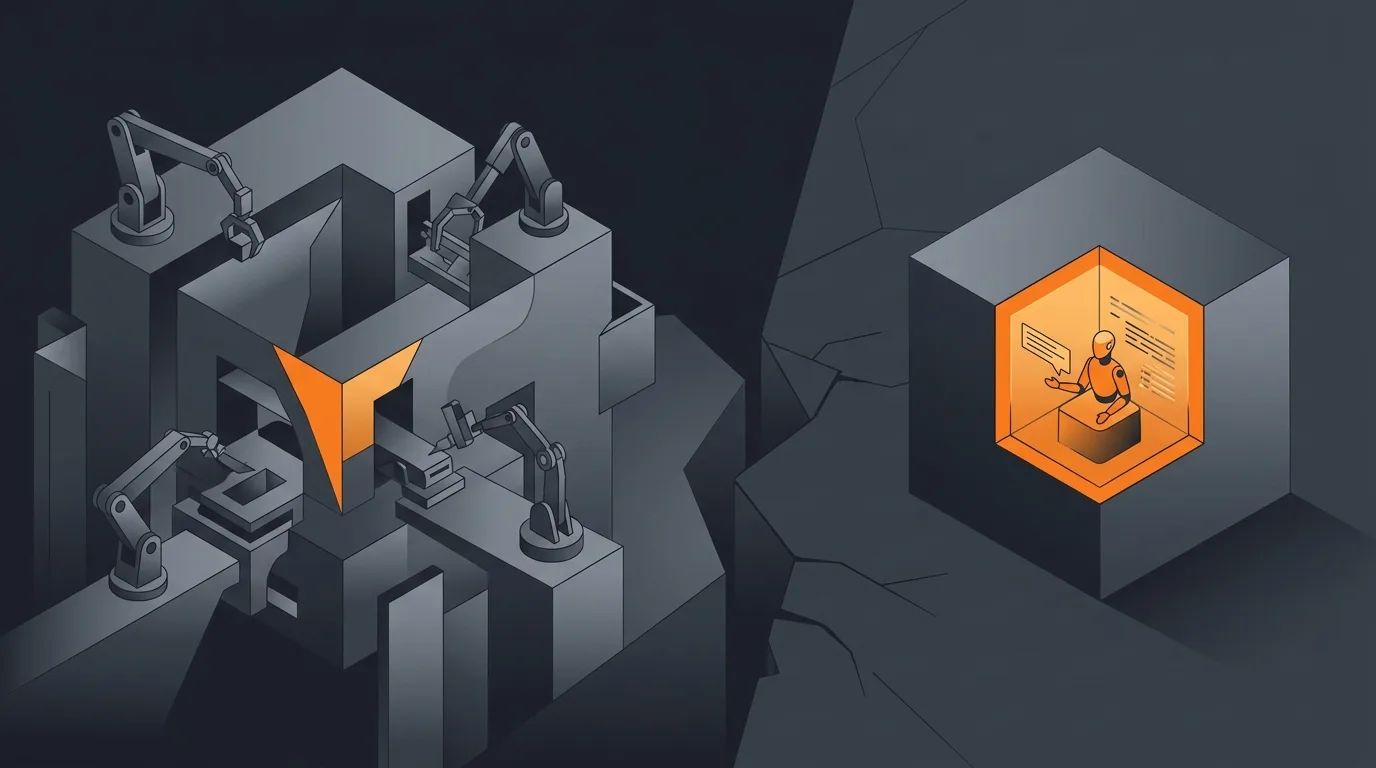
The framing that matters. A platform is a product whose roadmap optimises one job. A feature is one capability inside a product optimising a different job. ChatGPT Workspace Agents is a feature inside ChatGPT, which is fundamentally a chat product. Gravity is a platform whose only job is agents. The same noun ("agent") covers different commitments.
Why the distinction is more than semantic
Three concrete consequences. First, roadmap. The platform ships agent features the feature cannot because the feature must also keep the chat product cohesive. Second, support model. The platform's support, docs, and account team are agent-focused; the feature's are ChatGPT-focused. Third, billing. The platform can price per outcome or per agent; the feature has to roll into the parent product's pricing logic.
For a deeper view of the build-vs-buy framing inside this distinction see build vs buy AI agent and AI agent deployment models.
Capability comparison
| Dimension | ChatGPT Workspace Agents | Gravity |
|---|---|---|
| Unit of work | Delegated task inside a chat | Deployed agent |
| Schedule / triggers | User-initiated | Cron, webhook, event, manual |
| Pricing model | Rolls into ChatGPT subscription | Per outcome (likely, pre-launch) |
| Integrations | Workspace, 365, Slack, growing connector library | Top SaaS native + MCP for long tail |
| Customisation depth | Bounded by ChatGPT product | Full agent definition and tool registry |
| Audit & monitoring | Within ChatGPT admin | Agent-first dashboard |
| Vendor concentration | OpenAI-only stack | Multi-model routing |
The enterprise-vs-team buying motion
Half of this comparison is procurement, not product. ChatGPT Enterprise is a procurement vehicle: a SaaS deal a large company signs once and rolls out. ChatGPT Workspace Agents inherits that vehicle. If your company is already inside an OpenAI master agreement, adding Workspace Agents is friction-free.
A focused agent platform is a different motion. The buyer is typically the team or function with a specific job to automate, not central IT. The contract is per-team, the proof-of-value is concrete, and the cost is justified per-outcome. For the broader framing on this see AI agent cost models.
When ChatGPT Workspace Agents is the right call
Three signals.
You are already standardised on ChatGPT Enterprise
The team has ChatGPT Enterprise seats, central IT signed the deal, and you are inside the OpenAI procurement vehicle. Adding Workspace Agents is one toggle. There is no new vendor friction.
The use cases are chat-augmented, not deployed
"Help me draft this email", "summarise this document", "find this customer logo". Ad hoc delegation. The agent does not need to run every day. The chat surface fits.
Procurement values a single vendor
For some companies, fewer vendors equals less compliance overhead. The bundle wins on procurement even if the focused platform would win on capability. This is a legitimate decision.
When Gravity is the right call
Three opposite signals.
The job is deployed, recurring, autonomous
"Greet every new customer", "follow up cold leads weekly", "reconcile invoices Monday". The agent runs without you. Chat-inside-ChatGPT is not the right surface.
You want focused roadmap commitment
You want every product decision to optimise the agent surface. OpenAI's roadmap optimises ChatGPT first; Workspace Agents is part of that. A focused platform makes a different commitment.
You want multi-model routing and per-outcome economics
Multi-model routing reduces vendor risk and tunes cost. Per-outcome billing aligns vendor incentives with buyer outcomes. Neither is naturally available inside a single-vendor chat product. See AI agent orchestration and three startups, three shutdowns for the deeper view.
Frequently asked questions
What are ChatGPT Workspace Agents?
ChatGPT Workspace Agents is OpenAI's enterprise agentic offering, bundled with ChatGPT Team and Enterprise plans. Announced on 22 April 2026, the product gives agents access to Google Workspace, Microsoft 365, Slack, and other connected systems. The unit of work is a delegated task inside ChatGPT. Pricing rolls up into the per-user ChatGPT subscription starting at $60 per user per month for Enterprise.
Is ChatGPT Workspace Agents a competitor to Gravity?
Partially, and only for the buyer who values bundle convenience over focused capability. ChatGPT Workspace Agents are a feature inside a chat product. Gravity is a platform built around deployed long-running agents. Both can complete some of the same tasks, but the buying motion, ownership model, and pricing structure are different categories.
Why would I choose a focused agent platform over ChatGPT Workspace Agents?
Three reasons. First, ChatGPT Workspace Agents inherit ChatGPT's chat-shaped UX, which is fine for ad hoc tasks but limiting for recurring ops. Second, OpenAI's roadmap optimises the chat product, not the agent surface. Third, you do not want a bundle pricing model when your unit cost is dominated by inference; per-outcome economics are cleaner.
When is ChatGPT Workspace Agents the right call?
When your team is already standardised on ChatGPT Enterprise, when procurement values a single vendor, when the use cases are mostly chat-augmented ad-hoc tasks rather than deployed daily ops, and when you want zero new vendor friction. The bundle wins on procurement. The focused platform wins on agent depth.
What is the strategic difference between platform and feature?
A platform is a product whose entire roadmap optimises one job. A feature is one capability inside a product optimising a different job. ChatGPT Workspace Agents is a feature inside ChatGPT, which is a chat product. Gravity is a platform whose only job is deployed autonomous agents. The same word covers different commitments.
Three takeaways before you close this tab
- ChatGPT Workspace Agents is a feature inside a chat product. Gravity is a platform whose only job is agents.
- Bundle wins on procurement. Focused platform wins on capability and economics.
- The fit test is the unit of work. Delegated chat task fits ChatGPT. Deployed daily agent fits Gravity.
Sources
- OpenAI, "Announcing ChatGPT Workspace Agents", April 2026, openai.com/blog
- OpenAI, "ChatGPT pricing", retrieved 2026-05-14, openai.com/chatgpt/pricing
- The Information, "OpenAI's agent push and the platform-vs-feature question", April 2026, theinformation.com
- Anthropic, "Building Effective Agents", retrieved 2026-05-14, anthropic.com
- Microsoft, "Microsoft 365 Copilot for partners", retrieved 2026-05-14, microsoft.com
- Gravity, "Three startups, three shutdowns", May 2026, three startups, three shutdowns