On this page
Somebody fills in your contact form at 11:40pm. Your reply goes out at 9:15 the next morning. By then they have filled in two more forms somewhere else.
Closing that gap is what people are buying when they search for an AI appointment setter. Something awake at midnight that answers, asks two qualifying questions and books the meeting while the lead still cares.
The category sells three separate products under one name, and most lists blur them together until the buyer picks the wrong one.
I run an AI agent platform. I read all four of these vendors' own pricing pages on 26 September 2026 and the links sit at the end. You will not find a booking-rate percentage here: the ones that circulate in this category do not trace back to a source worth citing.
Four AI appointment setters, plus where Gravity fits
- Something that actually talks on the phone: Retell AI, pay as you go at $0.07 to $0.31 a minute. The meter runs on conversation minutes.
- An agency running client accounts: GoHighLevel, $97 a month for Starter with 3 sub-accounts, plus the AI Employee add-on at $50 a month per sub-account.
- You only want the email tennis to stop: Calendly, free for one event type, then $10 a seat a month billed yearly. Callie, its AI assistant, is marked Beta.
- Web-form volume with reps to route it to: Chili Piper, from $1,250 a month billed yearly, with up to 15 seats included.
- The work stacked around the booking: Gravity does the reply, the prep and the CRM entry. No phone number, no outbound calling.
- Buy in this order: calendar and routing first, the follow-up worker second, a voice agent only once call volume makes a per-minute bill look cheap.
- Worth knowing before you shortlist: some tools in this category do not publish pricing publicly, which is itself a finding.
Three products, one phrase
"AI appointment setter" describes three separate purchases. Work out which one you are making before you look at a price, because they do not substitute for each other.
- Voice setters place or answer calls and hold a spoken conversation. Retell AI is the only voice product on this page.
- Inbound responders catch a form fill or a DM within seconds, ask a couple of qualifying questions in writing, and hand back a booked slot. This is what most people picture when they type the phrase into Google.
- Routing and scheduling layers take an already-qualified lead and put it in front of the right rep. Calendly and Chili Piper both sit here, at opposite ends of the price range.
Most people want the second thing, get sold the first, and would get further with the third plus something that owns the follow-up. Sorting out which of the three you are actually buying decides whether any price on this page counts as good value.
One boundary before the list. This post is about answering and booking other people's meetings. If the job is defending your own focus time, the best AI scheduling assistants for your own calendar are a different set of tools bought by a different person.
How I compared them
Four questions, asked of every tool here.
- Which of the three jobs does it do? Voice, inbound response, or routing and scheduling.
- How does the bill grow? Per minute, per seat, per sub-account, or flat. That one line explains most of the surprise invoices in this category.
- What does the free tier let you prove? A free tier that only shows you the interface proves nothing.
- Who is the buyer? A solo operator, an agency with ten client accounts and an enterprise inbound team each shop in a different aisle, whatever the homepage says.
Every number below came off the vendor's own pricing page on 26 September 2026. I have not called these agents, deployed one, or run a bake-off, and I am not going to write as though I had.
One more thing about the shortlist. Some tools in this category do not publish pricing publicly, which is itself a finding.
Describe the follow-up job to Gravity and an expert-built agent runs it. First agent free, no card. Gravity is in private alpha, so access goes through an application.
Quick comparison
| Tool | What it actually does | Who does the work | Starting price (Sep 2026) | Free tier | Best for |
|---|---|---|---|---|---|
| Retell AI | Voice and chat agents that hold the conversation | The AI talks; you write the prompt | $0.07 to $0.31 per minute, pay as you go | $10 in free credits | Phone-first teams with call volume |
| GoHighLevel | Runs client sub-accounts; AI Employee is the setting add-on | Your agency configures it, once per client | $97/mo Starter, plus AI Employee from $50/mo per sub-account | 14-day trial | Agencies with several client accounts |
| Calendly | Scheduling links, plus Callie for email scheduling (Beta) | The invitee picks a slot; Callie drafts the coordination | $10/seat/mo Standard, billed yearly | Yes, one event type | Solo operators and small teams |
| Chili Piper | Qualifies, routes and schedules leads off a web form | Your routing rules; your reps take the meeting | From $1,250/mo billed yearly, up to 15 seats included | None on the pricing page | Inbound demand at enterprise scale |
| Gravity | The work around the booking: reply, prep, CRM entry, recap | A published agent runs the task | First agent free; Pro $5/mo in the alpha; Max $20/mo | First agent free | Follow-up and admin. No calling, no phone number |
Prices are what each vendor's pricing page showed on 26 September 2026. Calendly's and Chili Piper's pages default to annual billing, so those are billed-yearly figures. Retell's $0.07 to $0.31 is a range; the low end assumes the cheapest model and voice.
1. Retell AI: the one that actually picks up the phone
Retell builds voice agents that talk. You configure the agent; Retell runs the conversation with whoever is on the line. It is the only voice product on this page.
Pricing is pay as you go, and Retell leans on it. Its own line: "Most voice AI platforms require annual contracts before you write a single line of code. Retell starts at $0, pay only for what you use." You get $10 in free credits and 20 free concurrent calls. Enterprise is custom, through sales.
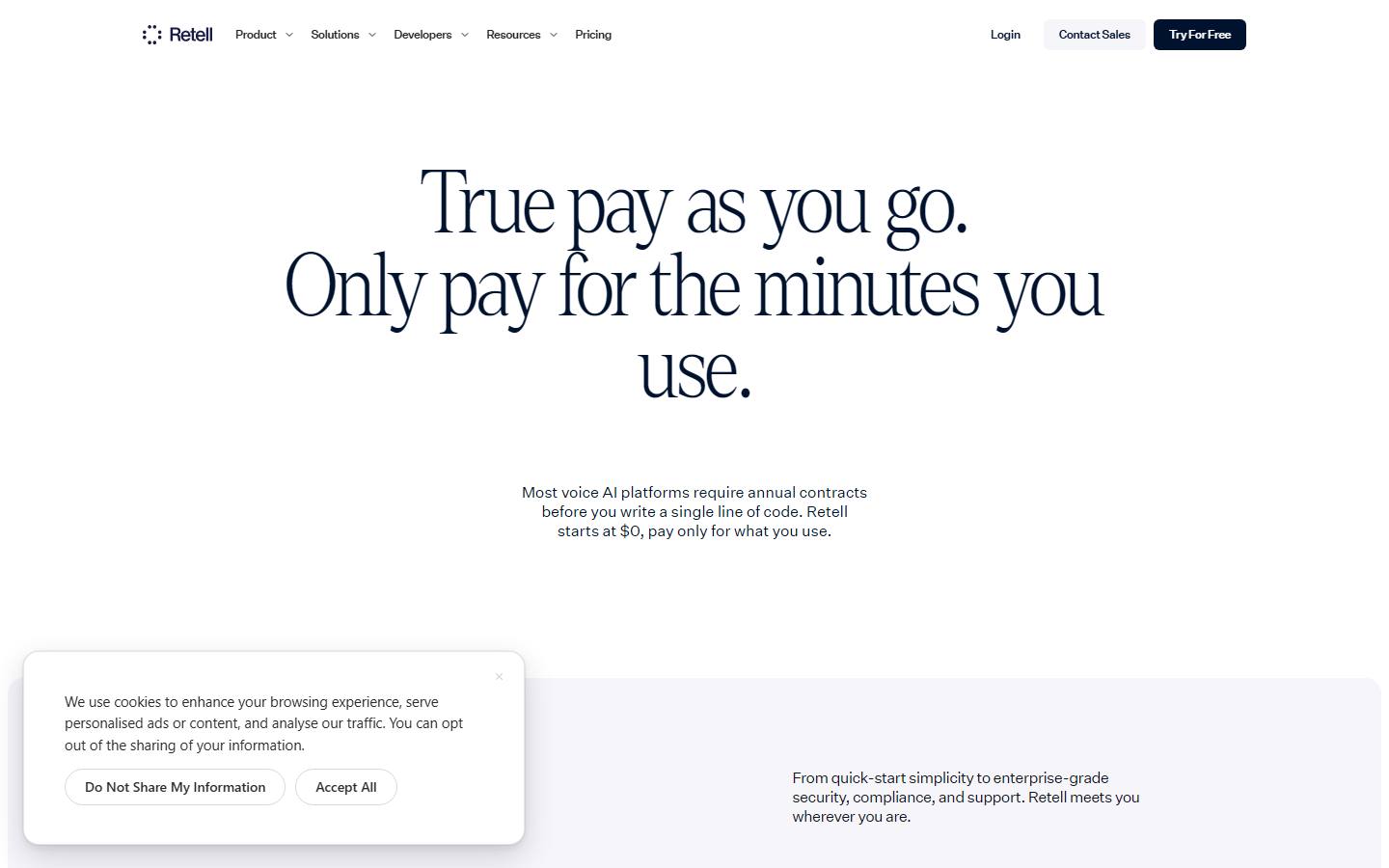
Voice agents run $0.07 to $0.31 a minute. Chat agents start at $0.002 a message. If your leads are cold, working a cold lead follow-up sequence in writing costs a fraction of a phone bill.
How a per-minute meter behaves on a long call
The bill scales with how long people talk. A caller who rambles for nine minutes and books nothing costs more than one who books in ninety seconds. Model your average call length before you switch anything on, and remember that the low end of that range assumes the cheapest model and voice.
- Best for
- Teams whose leads expect a phone call, with enough volume that a per-minute rate beats a salary.
- Pricing
- Pay as you go from $0. Voice $0.07 to $0.31 a minute, chat from $0.002 a message, Enterprise custom. As of September 2026.
- Free tier
- $10 in free credits, plus 20 free concurrent calls.
- Verdict
- The only voice option here. Start on the free credits and measure your average call length before you commit anything to it.
2. GoHighLevel: priced per sub-account, with the AI sold separately
GoHighLevel prices itself around sub-accounts, and a sub-account is usually one client. The appointment-setting piece arrives as a separate add-on called AI Employee, which is billed per sub-account as well.
Starter is $97 a month, or $970 a year if you pay annually, and covers 3 sub-accounts with unlimited contacts and unlimited users. Unlimited is $297 a month, or $2,970 a year if you pay annually. Agency Pro is $497 a month, or $4,970 a year on the same annual terms. There is a 14-day free trial. AI Employee is billed on top: $50 a month per sub-account on its Growth tier, $97 a month per sub-account on its Unlimited tier. Those were the figures in September 2026.

Why an agency pays for AI Employee once per client
Per sub-account is the phrase to sit with, and the sub-account allowance underneath it decides the platform fee. Starter covers three, so a ten-client agency is on the Unlimited plan at $297 a month before any AI is switched on. Ten AI Employee add-ons at $50 a month come to $500, which puts the bill at $797 a month. On the $97 add-on tier those same ten sub-accounts cost $970 a month, and the total reaches $1,267 a month. Count your clients first, because that one number sets both lines on the invoice.
Pros
- Unlimited contacts and unlimited users on Starter
- Plans are sized by sub-account count, so the platform fee tracks the client list
- 14-day free trial
Cons
- The AI add-on is priced per sub-account, so the AI line multiplies with the client list
- Two bills to track, platform and AI
- Starter stops at 3 sub-accounts, so a fourth client moves you up a plan
It suits someone already running several client accounts, where one add-on per client is exactly the point of the pricing. For a single business, you are paying for a structure built around client accounts you do not have. What an AI sales agent can and cannot own is the better starting point in that case.
If the monthly number is the blocker, the cheapest AI agent platforms compared sets out what this kind of work costs at the low end, free tiers and limits included.
3. Calendly: the layer most people already have
Calendly is the scheduling layer, and scheduling is a smaller job than setting. It publishes your availability, takes the slot choice off your plate, and ends the three-email argument about Tuesday.
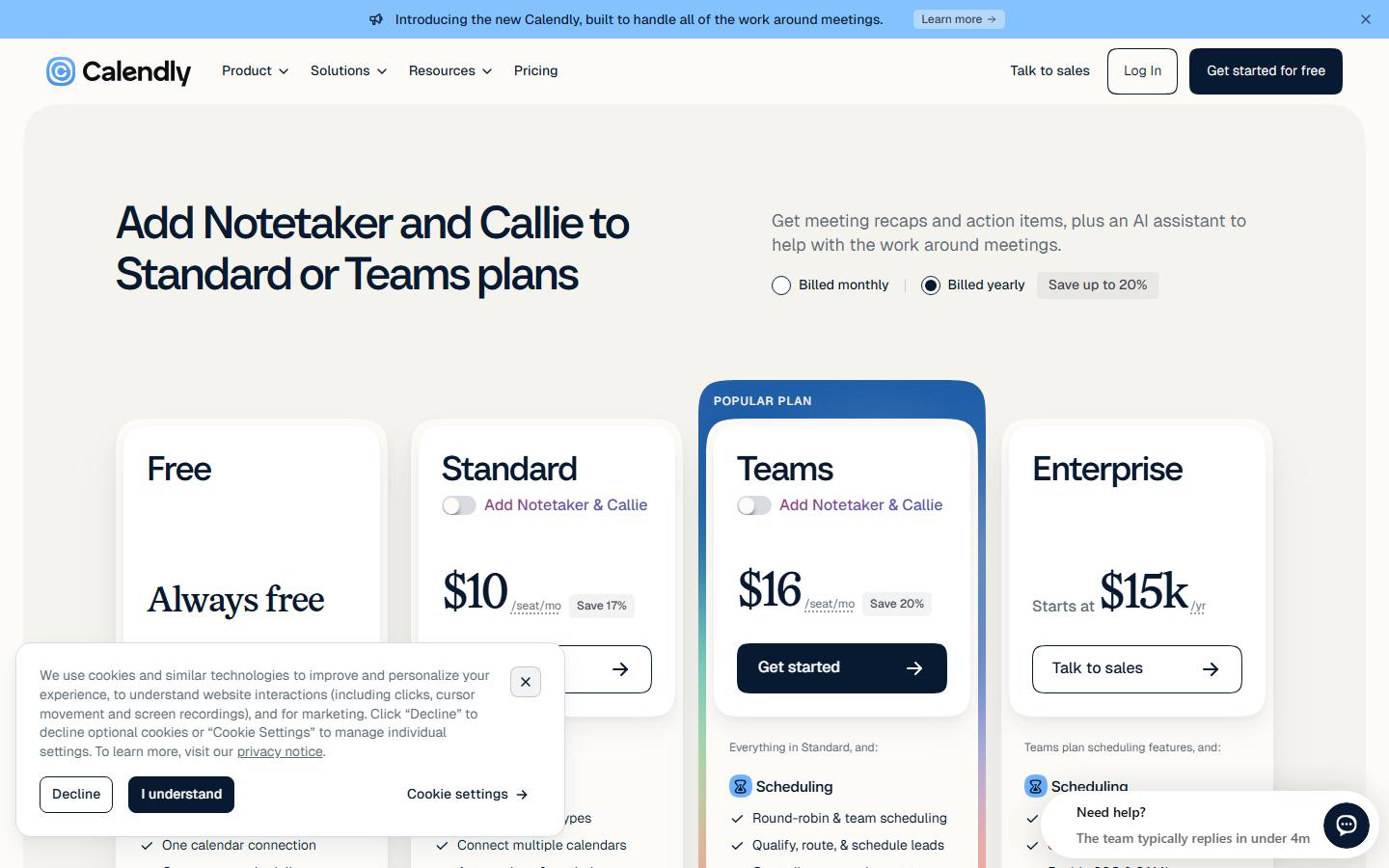
Free gives you one event type and one calendar connection. Standard is $10 a seat a month and Teams is $16 a seat a month, both billed yearly; the page advertises savings of up to 20% for paying yearly, so the monthly rate sits above those numbers. Enterprise starts at $15,000 a year with a 50-seat minimum, USD only. Seats count hosts only, so the people booking with you need none.
Callie, the beta that sits in your email thread
Callie is Calendly's AI assistant, marked Beta and available on Standard and above. Calendly describes it as an AI assistant for scheduling over email: add callie@calendly.com to a thread and let it suggest times, coordinate replies and book the meeting. It also handles one-off requests and meeting changes in the same thread, and answers questions about meeting prep and past conversation details.
That is closer to setting than a booking link is, and it is still an assistant working a thread you already started. For the two halves on their own, see scheduling straight into Google Calendar with an agent and researching a lead before the meeting.
- Best for
- Solo operators and small teams who want booking friction gone for the price of a coffee a month.
- Pricing
- Free for one event type. Standard $10 and Teams $16 a seat a month, both billed yearly. Enterprise from $15,000 a year, 50-seat minimum, USD only. As of September 2026.
- Free tier
- Yes, capped at one event type and one calendar.
- Verdict
- The cheapest honest answer when the calendar is the whole problem. Callie rides inside a plan you were buying anyway, with the Beta label taken seriously.
4. Chili Piper: inbound routing built for volume
Chili Piper owns the enterprise end of this market and does not pretend otherwise. It sits on your web form and, in its own words, instantly qualifies, routes and schedules leads from any web form. The demo request lands on the calendar of the rep your routing rules pick, before the visitor closes the tab.
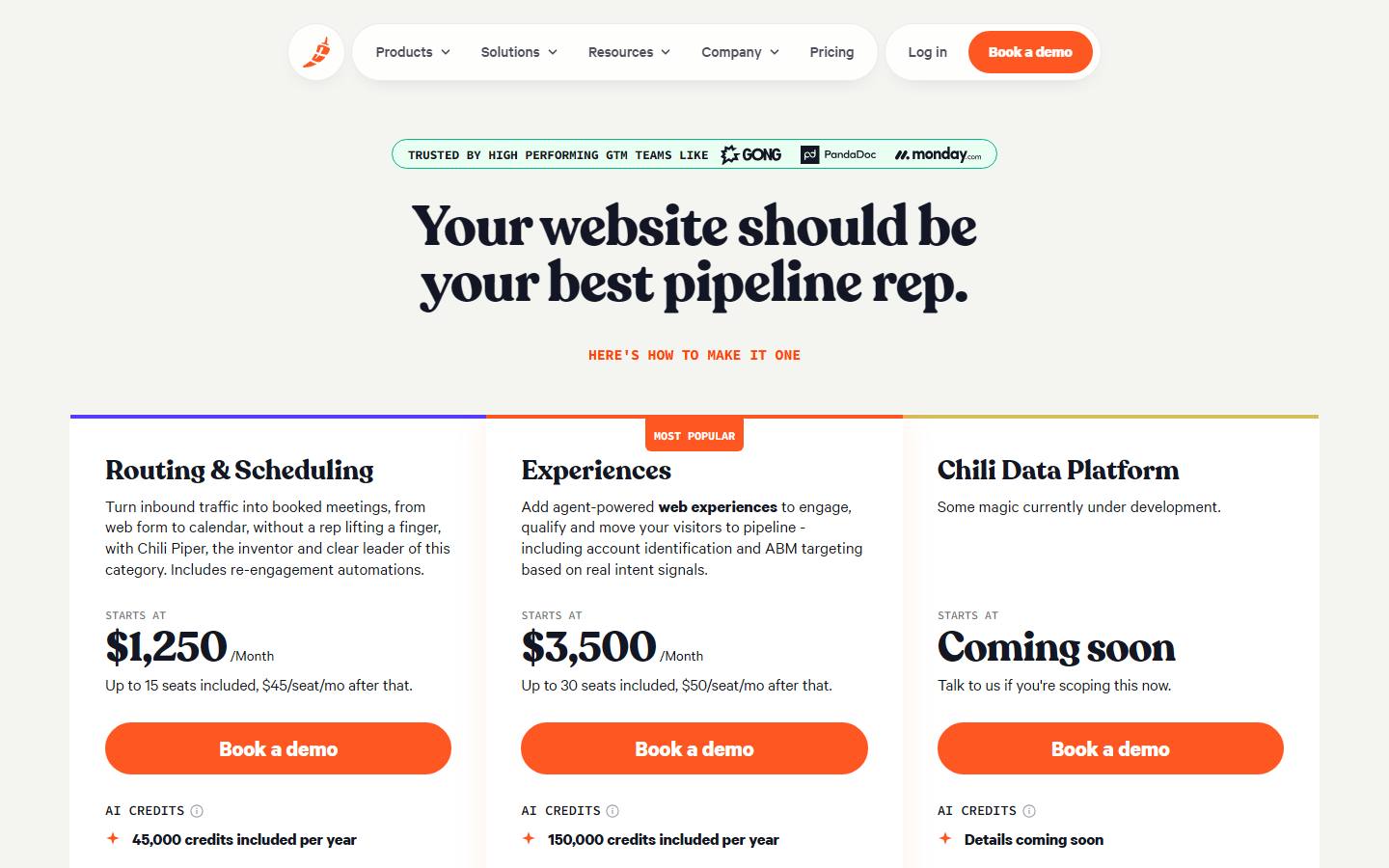
Routing and Scheduling starts at $1,250 a month billed yearly, includes up to 15 seats and 45,000 AI credits a year, then charges $45 a seat a month above 15. Experiences starts at $3,500 a month billed yearly, with up to 30 seats, 150,000 AI credits a year and $50 a seat after that. ChiliCal sells standalone at $12 a user a month with a 200-seat minimum. The pricing page defaults to annual billing, so check the toggle before you quote any of it internally.
Who is actually buying at the entry price
The buyer here runs a team. It takes enough inbound web-form traffic that a routing mistake costs real pipeline, plus reps sitting in seats waiting to be handed a meeting. A solo operator and a five-person agency both sit well below that line, and below it you are paying for routing machinery you have no use for.
Pros
- Qualification, routing and booking in one pass off the form
- Fifteen seats are included in the base price
- Built for teams where the right rep matters
Cons
- No free tier appears on the pricing page
- The entry price rules out most small businesses
- ChiliCal's cheaper per-user rate needs 200 seats, which is a different company entirely
Routing is only half the job. Once the meeting lands, somebody still has to prep it, run it and write it up, which is why logging the meeting back into HubSpot automatically tends to be the next thing these teams buy.
Where Gravity fits, and where it does not
This is my product, so weigh it accordingly. It earns a row here for one slice of the job and it is the wrong tool for the rest.
Gravity has no phone number. It does not dial out, it does not pick up, and it will never be the thing that calls a list of leads. If that is the job in front of you, Retell AI is the answer on this page.
What Gravity covers is the work stacked around the booking. It replies to an inbound enquiry in your words while you are asleep. It pulls together who the lead is and what they last said, before the call. Afterwards it writes the CRM entry and sends the recap with the next step attached, while the conversation is still warm.
You describe the task in plain words and a published agent runs it. The neighbouring jobs have their own agents already: following up after a sales call, turning meeting notes into CRM records, and chasing the actions a meeting produced.
What Gravity will not do
No outbound calling and no voice, as above. Gravity runs no routing rules across a sales team, which is what Chili Piper sells and sells well. It has no booking page of its own, so Calendly or whatever you already use still owns the calendar. Gravity is in private alpha, so the catalogue is short and access goes through an application.
Pricing is one price list for everyone. Your first agent is free, no card. After that Pro is $5 a month during the alpha, and Max is $20 a month for more agents and usage. You buy more usage from the account if you run out. As of September 2026.
There is a quicker test than shortlisting four vendors. Describe the follow-up job in one sentence and see whether an agent for it already exists. Apply to the alpha.
Which one should you choose?
Start with which of the three jobs is costing you money. The honest answer is usually cheaper than the shortlist you were about to build.
On the phone, Retell AI is the only tool here that does the work. Budget on conversation minutes.
Running client sub-accounts puts you on GoHighLevel, which is the only option here priced for that shape. Count the sub-accounts before you look at anything else: three of them fit on Starter at $97 a month, and ten mean the Unlimited plan at $297 a month plus one AI Employee add-on per client, from $50 a month each.
If the whole complaint is email tennis, Calendly ends it at $10 a seat a month billed yearly, and Callie comes inside that plan.
Chili Piper is built for genuine web-form volume with reps waiting on it, from $1,250 a month billed yearly. Below that volume the routing engine is expensive scaffolding.
At five inbound leads a week, none of these is your bottleneck. The eleven hours before anybody replies is the bottleneck, and that is a follow-up job.
My own bias, stated plainly. For a small team I would buy the cheap scheduling layer, put an agent on the replying, the prep and the CRM writing, and leave voice until the phone is genuinely where the leads are. AI agents for sales teams covers the wider stack around that call.
FAQ
What does an AI appointment setter actually cost?
The spread is wide. Retell AI starts at $0 with $10 in free credits, then charges $0.07 to $0.31 a minute for voice. Calendly Standard is $10 a seat a month billed yearly. GoHighLevel is $97 a month for Starter plus $50 a month per sub-account for AI Employee, and Chili Piper starts at $1,250 a month billed yearly. All as of September 2026.
Can an AI appointment setter call my leads?
Only some of them. Retell AI is the voice product on this page, holding a spoken conversation at $0.07 to $0.31 a minute as of September 2026. Calendly, Chili Piper and Gravity do not place calls.
Is there a free AI appointment setter?
Free tiers exist, each with a boundary. Calendly's free plan covers one event type and one calendar connection, Retell AI hands you $10 in free credits, GoHighLevel runs a 14-day trial, and Gravity runs your first agent free. No free tier appears on Chili Piper's pricing page, as of September 2026.
What is the difference between an appointment setter and a scheduling tool?
A scheduling tool publishes your availability and lets someone pick a slot. A setter is meant to do the part before that: read the enquiry, ask the qualifying questions and decide the meeting is worth having. Plenty of products sold as setters are scheduling tools with a form in front of them.
Does Calendly have an AI appointment setter?
Calendly has Callie, marked Beta and available on Standard and above. Calendly describes it as an AI assistant for scheduling over email: you add callie@calendly.com to a thread and it suggests times, coordinates the replies and books the meeting. It also handles meeting changes in the same thread.
How much does GoHighLevel's AI Employee cost?
AI Employee is $50 a month per sub-account on its Growth tier and $97 a month per sub-account on its Unlimited tier, as of September 2026. It sits on top of a platform fee, and the platform fee depends on how many clients you run. Starter is $97 a month and covers 3 sub-accounts, so ten clients puts you on the Unlimited platform plan at $297 a month plus ten add-ons. At $50 each, that is $500 of add-ons and $797 a month in total.
Which AI appointment setter suits a solo founder?
Chili Piper is the wrong end of the market at $1,250 a month billed yearly, since it is built for teams with routing rules and reps to route to. A solo founder gets further with a cheap booking link plus something that handles the replying, the prep and the CRM writing, such as an agent that logs the activity into Pipedrive after each call. Personal AI agents covers the same buyer from the other direction.
Sources
- Retell AI pricing, read 26 September 2026.
- GoHighLevel pricing, read 26 September 2026.
- Calendly pricing, read 26 September 2026.
- Chili Piper pricing, read 26 September 2026.
- Gravity pricing, September 2026.