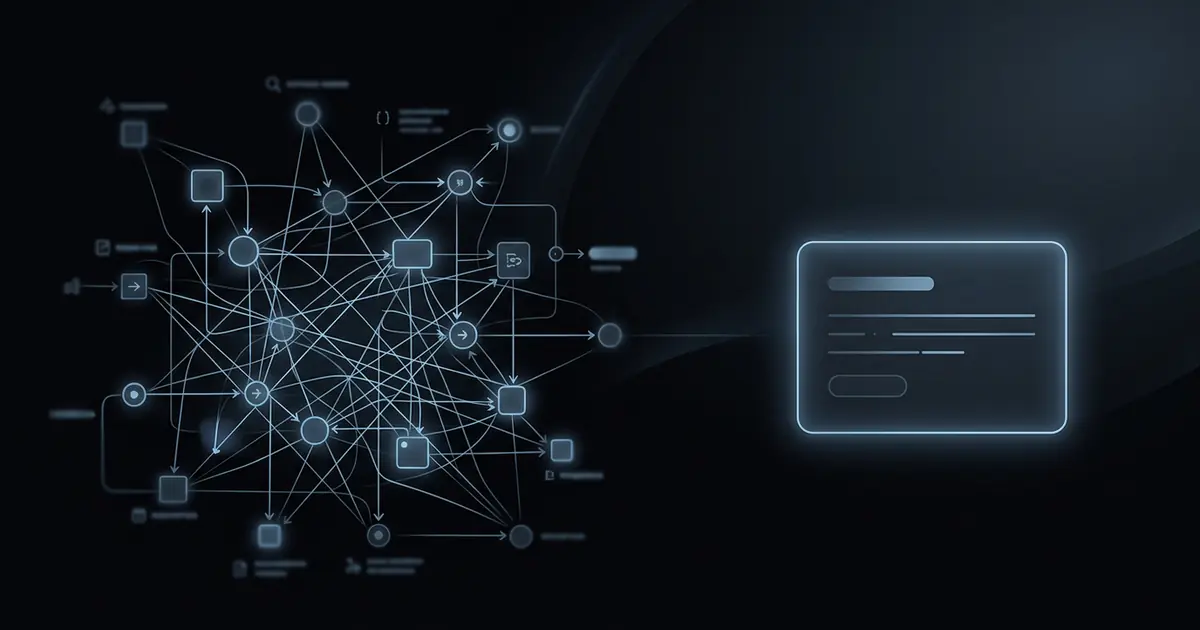
Workflow automation and AI agents look like the same product category from a distance. They run things on your behalf, integrate with your tools, and remove drudgery. Up close, they are different abstractions, with different user models, different failure modes, and different addressable markets. The buyer who treats them as interchangeable will pick the wrong one for at least half their use cases.
This post is the structural comparison. The opinionated case against pre-agent workflow tools lives in describe outcome, not workflow. The timing argument lives in why I bet against workflow platforms in 2026. This piece is the definitional version, calibrated for buyers who want a fair comparison.
Two automation models
Workflow automation. Tools like Zapier, Make, n8n, Workato, Tray, and the long tail of integration-platform-as-a-service vendors. The user designs the path. They pick a trigger ("when an email arrives"), a step ("extract this field"), a condition ("if subject contains X"), and an action ("create a ticket"). The user authors the program; the tool runs it. The editor is the product surface; the user's investment is in learning trigger-step-action thinking.
AI agents. Tools like Gravity and the broader 2025-2026 wave of autonomous agent platforms. The user describes the outcome ("triage my inbox before 9am"). The agent chooses the path: when to run, what to read, what tools to call, when to stop. The description box is the product surface; the user's investment is in describing the goal cleanly.
The two models share the substrate (APIs, integrations, authentication) but differ in who designs the path. That single architectural decision propagates through the user model, the failure modes, the addressable market, and the pricing. Most other differences are derivative.
Why the line moved in 2024-2025
Workflow automation was the right answer in 2014. The model technology of that era could not figure out a multi-step plan reliably from a description, so the user had to design the plan and the tool had to execute. By 2024, the model technology had crossed a quality threshold where it could choose paths the user previously had to design, especially for the long tail of "if this happens, do that" automations that did not require regulatory rigor.
The change is empirical, not philosophical. Anthropic's "Building Effective Agents" engineering post and OpenAI's Assistants API documentation both describe specific architectural patterns that reliably translate outcome descriptions into tool-using plans. The GAIA benchmark and SWE-bench leaderboards quantify the trajectory. As of late 2025, agents handle the recurring digital tasks Zapier was originally designed for at meaningfully higher reliability than a hand-built Zap when the underlying systems are well-instrumented.
Where agents win
Agents win on five axes for most everyday automation. Setup time. An agent reads a description; a workflow tool requires the user to author each branch. Maintenance. When a downstream API changes shape, the agent adapts; the workflow needs the user to edit the flow. Edge case coverage. The agent can handle inputs the workflow author never anticipated, within the bounds of its policy. Vocabulary. The agent speaks user-language; the workflow speaks tool-vendor-language. Addressable market. The agent is usable by anyone who can describe a task; the workflow tool requires programmer-style thinking.
The most underrated of these is the addressable-market gap. Workflow tools narrow the user pool to the subset of operators willing to learn trigger-step-action thinking. Agents open the same automation to anyone who can write a sentence. The 80-test methodology in how we test AI agents exists because reliability is the missing piece for unlocking that wider audience.
Where workflow tools still win
Workflow tools win where structure is the product. Three categories. Regulated workflows: healthcare claims processing, financial settlement, regulatory submissions. The trace must be auditable, the steps must be exact, and the system must not invent a step that was not in the documentation. Irreversible actions: wire transfers above thresholds, contractual signings, hard deletes. The cost of an unexpected step exceeds any productivity gain. Hard SLA constraints: automations whose latency or guaranteed-completion timing matters legally or operationally.
Workflow tools also win in the short term where the integrated user base is the asset rather than the technology. A team that already lives in Workato or Zapier has invested learning, governance, and templates in that environment. Migrating to an agent platform may not pay for itself even if the agent abstraction is technically cleaner.
The hybrid pattern
The most common production pattern in 2026 is hybrid. The outer shell is a workflow tool with explicit steps for the parts that need governance and audit. Some of those steps are agent-style: a single step in the workflow says "agent, do this", and the agent runs its own loop, returns a structured result, and hands control back to the workflow.
The hybrid pattern lets buyers preserve the audit trail and SLA guarantees of the workflow tool while getting the reasoning capability of an agent for the parts that benefit from it. Major workflow vendors have added agent steps to their product surface during 2024-2025. The boundary between agent and workflow is moving from "either-or" to "embedded".
How to choose
Three questions tell a buyer which abstraction to pick. Does the user want to design the steps, or describe the outcome? Step-design users buy workflow. Outcome-describe users buy agent. Does the task have a fixed step list, or can the steps vary safely? Fixed-list tasks belong in workflow. Variation-tolerant tasks belong in agents. Does compliance require an exact audit trail, or is sample-based review enough? Strict-audit cases stay workflow. Sample-review cases move to agents.
Two outcome-leaning answers and one variation-safe answer: agent. Two step-leaning answers and one strict-audit answer: workflow tool. Mixed answers: hybrid. The future hub at what is an autonomous AI agent walks through the agent-side decision in more depth.
Gravity is built around the agent end of the spectrum, with explicit hooks for hybrid use. The economics math sits at economics of bootstrapped AI agents; the bootstrapping logic is at bootstrapping an AI agent platform.
Frequently asked questions
What is the difference between AI agents and workflow automation?
Workflow automation tools ask the user to design the path: trigger, step, condition, action. AI agents ask the user to describe the outcome and figure out the path themselves. The user effort moves from authoring the program to describing the goal. The change is structural, not cosmetic, and it expands the addressable user base substantially.
Will AI agents replace Zapier?
AI agents will replace Zapier for the majority of use cases where users do not want to think like programmers. Zapier will retain the categories that genuinely need step-by-step control: regulated, irreversible, audit-heavy automation. Most consumer and operator automation does not structurally need a workflow editor, which is what makes the agent abstraction win there.
When is workflow automation better than an AI agent?
Workflow automation is better when the steps must be exact, when the order matters legally or operationally, when the trace must be audited, or when the cost of an unexpected step exceeds the productivity gain. Surgical, financial-settlement, regulatory-submission, and irreversible-action workflows belong in step-by-step tools, not in agents.
Can an AI agent run inside a workflow automation tool?
Yes, and this hybrid pattern is increasingly common. The workflow tool handles the orchestration with explicit steps for compliance and audit; the agent handles the steps that need reasoning. Most major workflow vendors now offer agent-style steps inside the otherwise-explicit workflow. The hybrid sits in the middle of the spectrum.
How do I choose between agent and workflow tool?
Three questions. Does the user want to design the steps, or describe the outcome. Does the task have a fixed step list, or can the steps vary safely. Does compliance require an exact audit trail, or is sample-based review acceptable. Two outcome-leaning answers and one safe-variation answer means agent. Two step-leaning answers and one strict-audit answer means workflow tool.
Three takeaways before you close this tab
- The path-author is the difference. User authors path: workflow. System authors path: agent.
- Models crossed a threshold in 2024-2025. The agent abstraction is now reliable enough to win the long tail.
- Hybrid wins production. Workflow shell, agent steps where reasoning helps.
Sources
- Anthropic, "Building effective agents", 2024 engineering post, anthropic.com/engineering
- OpenAI, "Assistants and Tool Use documentation", accessed 2026-05-05, platform.openai.com/docs
- GAIA benchmark, 2023, arxiv.org/abs/2311.12983
- SWE-bench leaderboard, accessed 2026-05-05, swebench.com