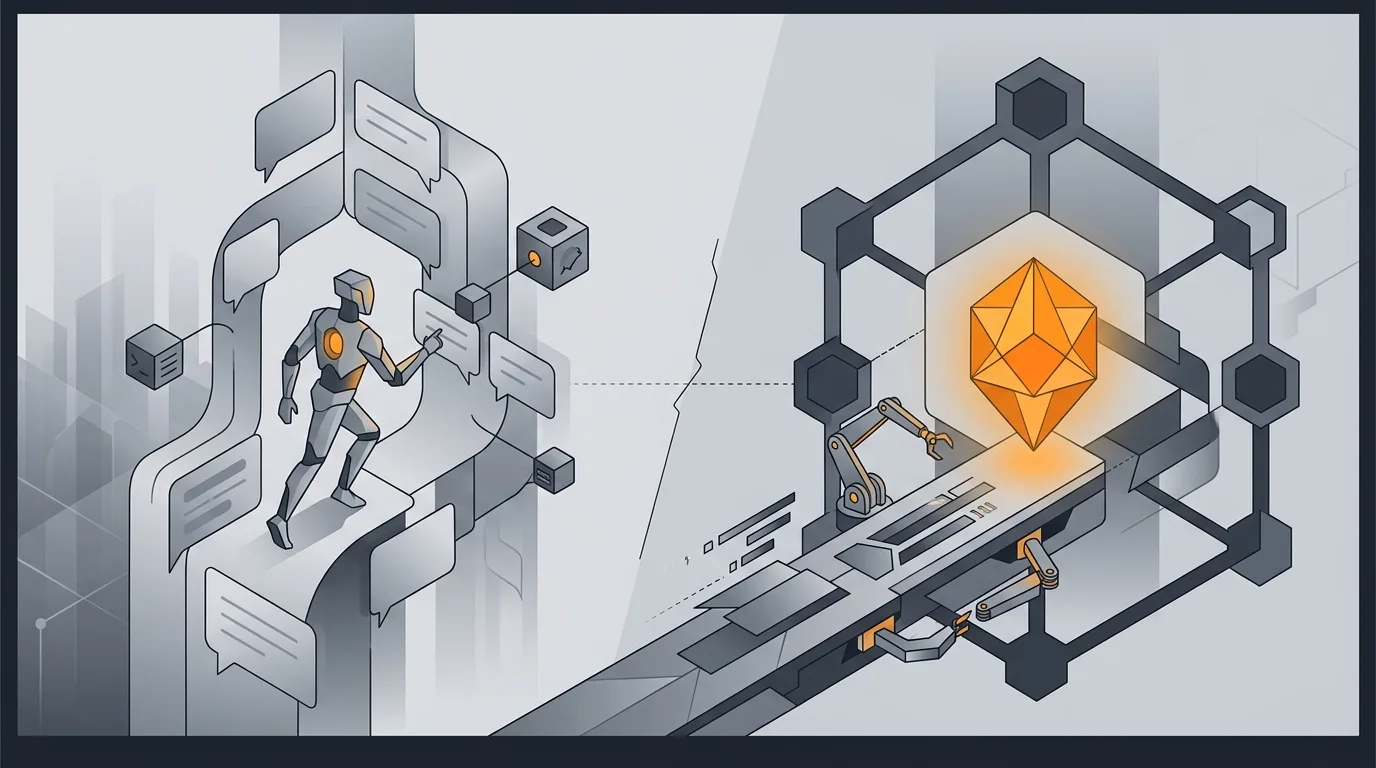
Botpress and Gravity are often compared because both call themselves agent platforms. Look closer and the design centres are different. Botpress is a chat platform with agent capabilities. Gravity is a headless runtime with no chat surface at all.
What Botpress is, and where it actually shines
Botpress is a long-standing chatbot platform that has spent the last few years repositioning around AI agents. The product has a visual flow builder, omnichannel deployment to web, WhatsApp, Messenger, and other surfaces, plus an LLM layer for generative responses.
Where Botpress shines:
- Customer-facing chat on a website widget.
- WhatsApp and other messaging channel deployments.
- Dialog management for intent detection, follow-ups, and fallbacks.
- Teams with an existing chatbot footprint who want to layer in generative AI.
- Use cases where the conversation is the product.
If you are buying a chatbot, Botpress is one of the strong candidates. The dialog primitives are mature.
What Gravity does differently
Gravity has no chat surface. There is no widget, no WhatsApp connector, no dialog manager. The agent does not talk to anyone. It does work in the background and surfaces results internally.
"Every morning at 6am IST, scrape competitor pricing pages for Lindy, Zapier, and Make. If any price changed by more than 10 percent, post the diff in our #competitive Slack channel. Stop after one alert per competitor per day."
That is a Gravity agent. No customer talks to it. It just runs. Describing outcomes is the only surface.
Side-by-side capability comparison
| Capability | Botpress | Gravity |
|---|---|---|
| Primary surface | Conversational | Headless |
| Setup model | Flow builder, dialog manager | One sentence |
| Channel coverage | Web, WhatsApp, Messenger, Slack, SMS, more | No customer-facing channels |
| Dialog management | Mature | Not applicable |
| Scheduled jobs | Supported with triggers | First-class in prompt |
| Operator persona | Conversation designer or engineer | Founder or ops lead |
| Pricing model | Tiered with usage and seats | Bundled monthly fee |
The chat-first vs ops-first split
Chat-first platforms optimise for the moment a human is on the other end. Latency, tone, fallback paths, escalation to a human. Ops-first platforms optimise for unattended runs. Scheduling, idempotency, rate limits, approval queues.
The two are different products at the seams even if the marketing overlaps. If you forecast that 80 percent of your agent volume will be conversation, buy a chat platform. If you forecast that 80 percent will be unattended work, buy an ops runtime.
For a full take on why operational agents are a distinct category, see what an AI agent can actually do.
Pricing reality
- Botpress: Tiered, with usage credits and seat-based pricing. Enterprise tiers add SSO and compliance.
- Gravity: Bundled monthly fee.
When Botpress is the right choice
- You have a customer-facing chat use case.
- You need omnichannel deployment.
- You have a conversation designer on the team.
- You want a mature dialog manager.
- You are layering generative responses onto an existing chatbot footprint.
When Gravity is the right choice
- Your agents are headless and operational.
- You do not want to design conversations.
- You want scheduled jobs as a first-class concept.
- Your operator is a founder or ops lead.
- You want one bundled bill, zero dialog modelling.
Migration: what changes if you switch
You usually do not migrate from Botpress to Gravity, you add Gravity alongside. The chatbot stays on Botpress for the customer-facing flows. New operational agents go on Gravity.
If you do want to migrate a specific Botpress flow that has become operational rather than conversational, follow the same pattern as how to migrate from Zapier to an agent: outcome sentence, reconnect OAuth, dry run, cut over.
Frequently asked questions
Is Botpress still a chatbot platform?
Originally yes, but Botpress has repositioned around AI agents over the past few years. The underlying surface is still well-suited for conversation, and the dialog manager is mature.
Where does Botpress shine today?
Customer-facing chat agents on websites, WhatsApp, Messenger, and similar channels. The omnichannel deployment story is one of the strongest in the market.
Why pick Gravity instead?
If your agent does not talk to a customer, you do not need a chat platform. Gravity is for headless agents that run on a schedule, take action, and surface results in Slack or Notion.
Can Botpress agents run autonomously without chat?
Yes, with triggers and scheduled flows. The design centre is still conversational, so non-chat use cases need more configuration.
Which has better integrations?
Botpress has the deeper integration catalogue today, especially for messaging channels. Gravity is growing its native catalogue and prioritises operational tools like Gmail, Slack, HubSpot, and Stripe.
Three takeaways before you close this tab
- Chatbots are not agents and agents are not chatbots. The category labels blur. The design centres do not.
- Buy Botpress if the agent talks. Buy Gravity if the agent acts.
- Most real businesses need both. Plan for two budgets.
Sources
- Botpress. "Official product page." botpress.com
- Botpress. "Pricing." botpress.com/pricing
- Botpress. "Documentation." botpress.com/docs