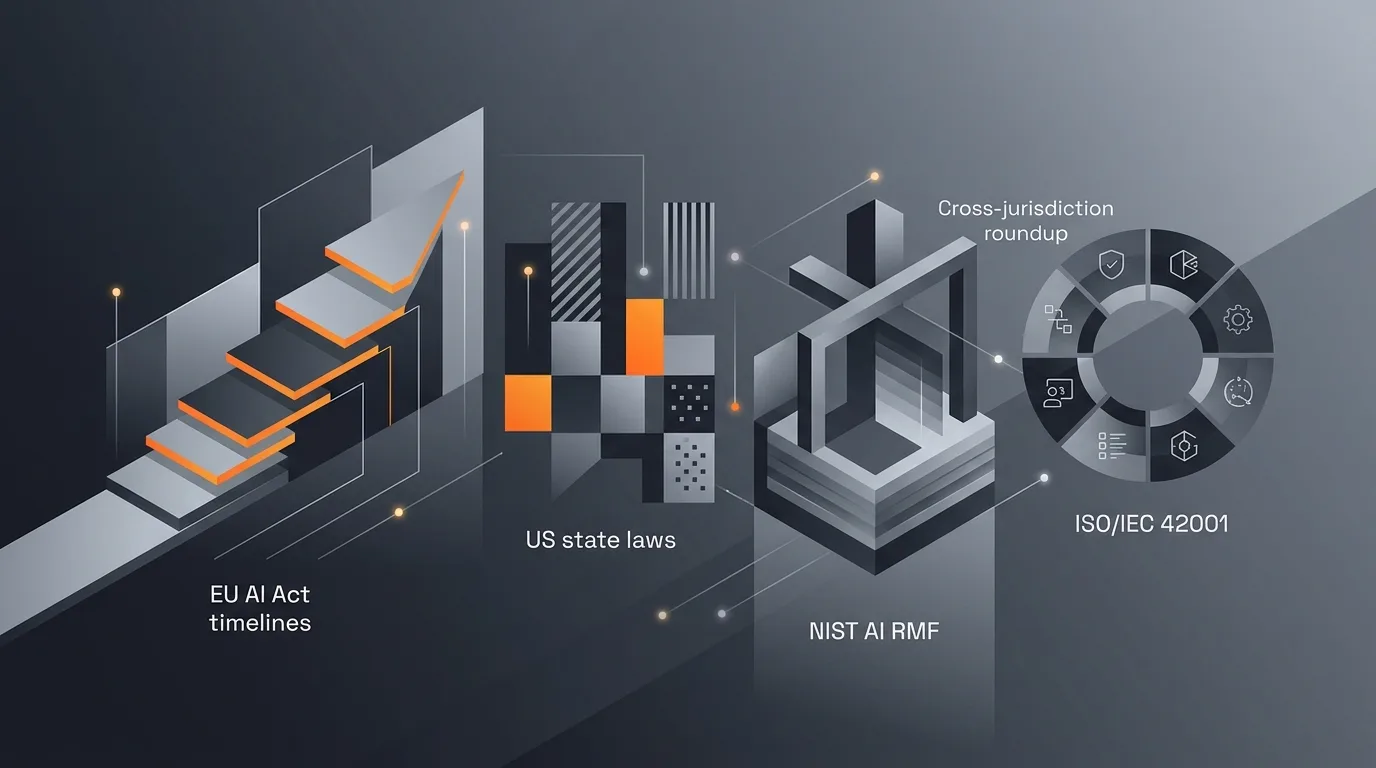
As of mid-2026, there is no single AI agent law to comply with; there is a layered landscape you have to navigate at once. The EU AI Act is in phased enforcement, several US states have their own AI rules, the NIST AI Risk Management Framework sets a voluntary baseline that buyers increasingly expect, ISO/IEC 42001 offers a certifiable management standard, and long-standing sectoral rules in areas like finance and health still apply on top. This roundup walks through each and what it means in practice for teams deploying AI agents: transparency, risk classification, human oversight, and record-keeping.
This is the cross-jurisdiction overview. If you specifically need the EU regime in depth, our EU AI Act deep dive covers the obligations, timelines, and definitions in detail. This post stays broader, mapping the EU alongside the US and the major standards so you can see where your deployment sits across all of them at once. Regulatory dates move, so treat every specific timeline below as accurate to mid-2026 and verify against the primary source before you act on it.

The mid-2026 landscape at a glance
The practical reality for anyone deploying agents is that compliance is no longer hypothetical. The same obligations show up under different names across jurisdictions, so it helps to think in themes rather than statutes. Four recur almost everywhere: transparency, meaning people should know when they are dealing with or affected by an AI system; risk classification, meaning higher-stakes uses carry heavier duties; human oversight, meaning a person can review and override the system; and record-keeping, meaning you can show what an agent did and why.
Those four themes map cleanly onto the rest of this post. The EU AI Act codifies all four into binding law. US state laws emphasize transparency and oversight for consequential decisions. The NIST framework and ISO standard give you a structure to implement them voluntarily. Sectoral rules add domain-specific versions of the same ideas. If you build to the themes, you are most of the way to satisfying the specific texts.
EU AI Act: phased enforcement
The EU AI Act is the most comprehensive AI law in force as of mid-2026, and it does not arrive all at once. It applies in phases, with different obligations switching on at different dates, which is why "is the AI Act in effect" has no single yes-or-no answer. The earliest provisions, including prohibitions on certain unacceptable-risk uses, took effect first, followed by obligations on general-purpose AI models, with the heaviest high-risk-system requirements phasing in later. The official source for the timeline is the European Commission's regulatory framework page.
Risk classification and high-risk obligations
The Act sorts systems by risk: unacceptable uses are banned, high-risk uses carry the bulk of the obligations, limited-risk uses owe transparency, and minimal-risk uses are largely unregulated. For agents, the tier is set by the use case. An agent that screens job applicants, scores credit, or supports an essential public service is likely high-risk and inherits duties around risk management, data governance, human oversight, logging, and conformity assessment. The same underlying model wrapped around a low-stakes task may sit in a far lighter tier.
General-purpose AI obligations
Separately, the Act places obligations on providers of general-purpose AI models, including documentation, transparency about training data at a summary level, and, for the most capable models, additional systemic-risk duties. Most teams deploying agents are deployers rather than model providers, so the high-risk and transparency rules usually matter more to them than the GPAI provider rules, but it is worth knowing which hat you wear, because the obligations differ.
US state-level activity
The United States has no single comprehensive federal AI law as of mid-2026, so the action is at the state level, and it is a patchwork. The most cited example is the Colorado AI Act, which targets consequential decisions made or substantially influenced by AI and imposes duties such as risk management and disclosure to affected people. California has pursued its own set of AI measures covering transparency and automated decision-making. Primary status for any specific bill is best checked on the relevant legislature site, such as the Colorado General Assembly.
For a team deploying agents to US users, the takeaway is structural rather than line-by-line: because requirements differ by state and several touch the same high-stakes domains, hiring, lending, housing, insurance, you often have to satisfy several state rules at once if your users are spread across the country. The common denominator across them, transparency about automated decisions plus a path for human review, is a sound thing to build whether or not a given state requires it yet. The OECD AI Policy Observatory tracks the broader policy picture across jurisdictions if you need to see how the US fits internationally.
NIST AI RMF and ISO/IEC 42001
Two voluntary instruments do a lot of the practical work, because they translate principles into something you can actually implement. The first is the NIST AI Risk Management Framework, which organizes AI risk work into four functions, govern, map, measure, and manage, and ships with a Generative AI profile that addresses risks specific to generative systems. It is not law, but regulators, customers, and procurement teams increasingly treat it as the baseline for what responsible looks like, which is why adopting it tends to make later legal compliance easier rather than harder.
The second is ISO/IEC 42001, an international standard for an AI management system, the AI equivalent of how ISO/IEC 27001 works for information security. Where NIST gives you a framework, 42001 gives you something you can be audited and certified against, which matters when a customer or regulator wants third-party assurance rather than a self-attestation. The two complement each other: NIST for the risk practices, 42001 for the management structure around them. Neither replaces a binding law, but together they form a credible compliance backbone that maps onto most of what the EU and US texts ask for. Building these practices in is closely related to the controls covered in our notes on AI agent governance and compliance and SOC 2 for AI agents.
Sectoral rules that already apply
It is easy to fixate on new AI-specific law and forget that existing sectoral regulation already governs many agent deployments. An agent making credit decisions sits under financial-services and fair-lending rules. An agent touching patient data sits under health-privacy law. An agent processing the personal data of EU residents sits under the GDPR regardless of the AI Act. These rules predate the current AI wave, but they apply to AI systems just as they apply to any other tool, and they often impose the most concrete duties you will face in the short term.
Two recurring sectoral themes deserve naming. Data residency and cross-border transfer rules constrain where agent data can be processed and stored, which is a practical deployment question covered in AI agent data residency. And record-keeping and traceability requirements mean you need to be able to reconstruct what an agent did, which is exactly what AI agent audit trails are for. Both are themes that the EU AI Act and the standards reinforce rather than replace, so investment there pays off across every framework at once.
What deploying teams should do now
You do not need a law degree to start; you need an inventory and four habits. Begin by listing where your agents make or influence consequential decisions, since that is what almost every regime keys on. Then put in place the controls that satisfy most rules simultaneously: tell affected people when an AI system is involved, keep a human able to review and override, log what each agent does in a durable trail, and maintain a plain record of each agent's purpose and behavior. The practical checklist in our AI agent compliance audit checklist turns this into concrete steps, and the broader hardening practices in AI agent security best practices back it up.
Two cautions. First, do not treat any single date in this post as settled; phased enforcement means the picture changes quarter to quarter, so confirm specifics against the primary regulator source before you rely on them. Second, resist the urge to over-engineer for the highest-risk tier across every deployment. Map each agent to its actual use case and apply duties proportionate to its real risk. A low-stakes internal summarizer and a hiring screen do not belong in the same compliance bucket, and treating them as if they do wastes effort that should go to the deployments that genuinely carry risk.
How Gravity handles AI agent regulation
Gravity is an AI agent platform built so that the operational side of compliance is not yours to assemble from scratch. You describe the outcome in plain words, and an expert-built agent runs it and hands back the finished result in about 60 seconds. Because Gravity runs and maintains the agents and carries the cost of running them, the platform is responsible for the service rather than handing you a raw model to govern alone. That maps directly onto what regulation asks for: clear accountability for who is responsible when an agent acts.
The platform's design leans into the recurring regulatory themes. Pricing is a subscription with usage included, and every run is metered against your plan, which keeps a clean record of when work happened. Keeping a human in the loop on consequential outputs is a deliberate pattern rather than an afterthought, and traceability is treated as core, not optional. None of that makes a deployment automatically compliant; your specific obligations depend on your use case and jurisdiction. What it does is start you from a posture, accountable operator, human oversight, durable records, that aligns with the direction every framework in this roundup is heading. Gravity is on a waitlist as of mid-2026, and this post is general information, not legal advice; confirm your own obligations with qualified counsel.
FAQ
Does the EU AI Act apply to my AI agents if I am not in the EU?
It can. The EU AI Act applies based on where the output is used, not only where the provider sits. If your agent's results are used by people in the EU, the obligations can reach you even if your company is elsewhere. Treat EU exposure as a question of who uses the output, not just where you are incorporated.
Is the NIST AI Risk Management Framework mandatory?
No. The NIST AI RMF is voluntary guidance, not law. It is influential because regulators, customers, and procurement teams increasingly point to it as a baseline for responsible AI. Adopting it does not make you compliant with any specific statute, but it gives you a defensible structure that maps cleanly onto most emerging legal requirements.
What is a high-risk AI system under the EU AI Act?
High-risk uses are those the Act lists as having significant potential to affect safety or fundamental rights, such as systems used in hiring, credit, education, or essential services. Agents in these areas face the heaviest obligations: risk management, data governance, human oversight, logging, and conformity steps. The risk tier is set by the use case, not the technology.
What do US state AI laws require of agent deployments?
It varies by state as of mid-2026, but common themes are transparency about automated decisions, duties around consequential decisions in areas like employment and housing, and impact assessments for higher-risk uses. There is no single federal AI law, so deployments touching US users often have to satisfy a patchwork of state requirements at once.
How should a small team start preparing for AI regulation?
Start by inventorying where agents make or influence consequential decisions, then add the basics that nearly every framework expects: transparency to affected people, a human able to review and override, audit logs, and a record of what each agent does. Those steps satisfy most rules at once and are good practice regardless of jurisdiction.