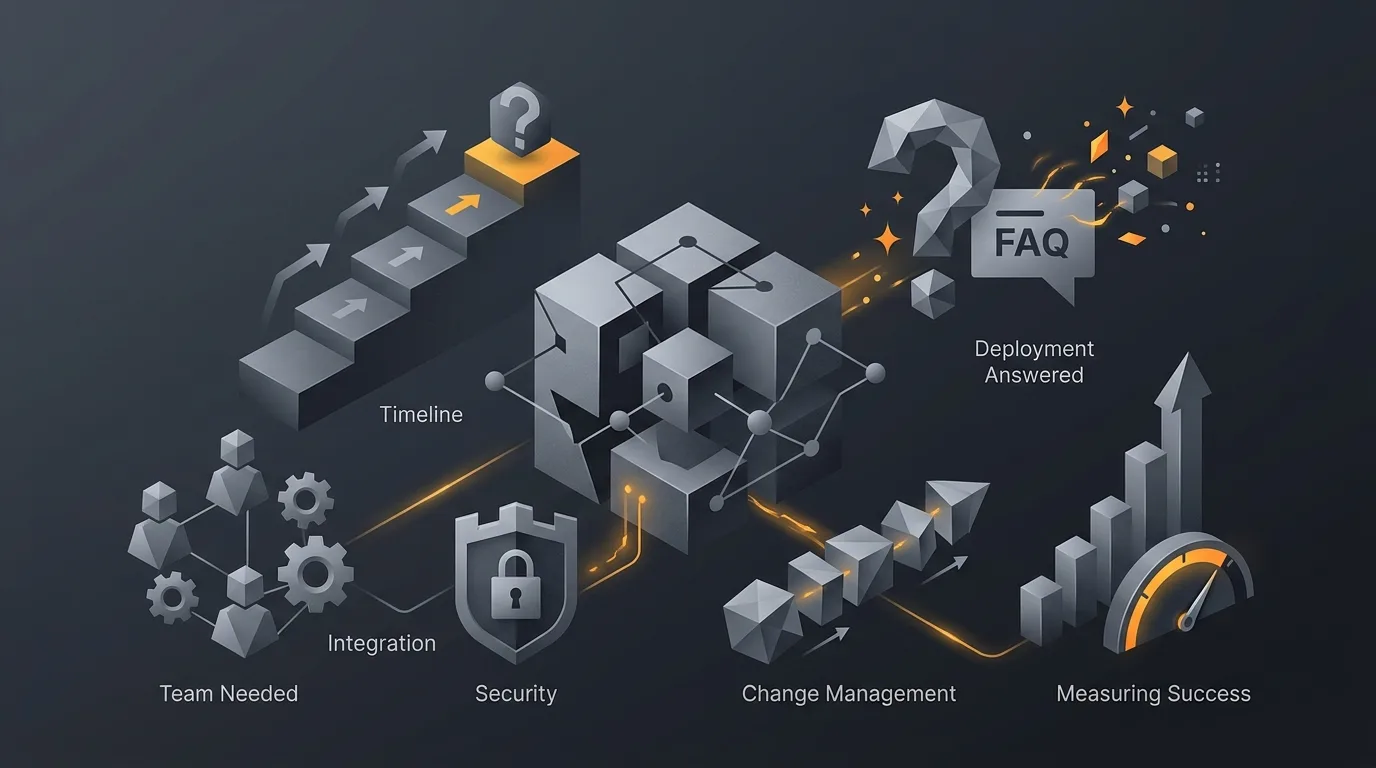
An AI agent implementation goes right when you start with one narrow, well-defined workflow, give the agent least-privilege access to the systems it needs, keep a human approving consequential actions, and measure the result against a baseline you recorded before you began. The hard parts are rarely the model; they are scope, integration, security, and getting people to actually use what you ship. This FAQ answers the questions buyers ask most before committing, grouped by theme, so you can plan a deployment that lands instead of stalling in a pilot that never reaches production.
The answers below assume you have already chosen a use case. If you are still at the selection stage, the criteria in how to evaluate AI agent platforms come first, and the staged view of the rollout itself lives in the implementation timeline.

Timeline and team
How long does implementation take?
The honest answer is that it ranges from days to months, and the range is decided by scope, not by the agent. A single, clearly defined workflow on a managed platform can be live in days because there is nothing to build: you describe the outcome, connect a source, and test. A custom agent built in-house and wired into several production systems takes weeks to months once you count integration work, a security review, testing, and sign-off. The biggest lever you control is the width of the first workflow. A narrow first deployment proves value fast and earns the room to expand.
What team and skills do I need?
For a managed platform, the core requirement is a domain owner: the person who knows the workflow, can describe the outcome precisely, and can judge whether the output is right. Add light IT involvement to grant access. Building in-house is a different staffing picture, adding engineering, data, security, and an operations function to keep the thing running. The role teams most often forget, in either model, is the business owner who defines what good looks like and reviews early output. Without that person, a technically perfect agent produces confidently wrong work that nobody catches.
Integration with existing tools
How do agents connect to the tools I already use?
An agent works through the same doors your other software uses: APIs, prebuilt connectors, or file exports and imports. It reads from and writes to the systems you run today, your CRM, spreadsheets, ticketing queue, billing platform, or email, under the permissions you grant. On a managed platform, those connections are maintained for you, so integration becomes a configuration step rather than a pipeline you build and babysit. In-house, integration is usually the single largest line item, since each connected system is code to write, secure, and maintain as the upstream tool changes.
What if my data is messy or spread across systems?
Most data is messy, and that is a normal starting condition, not a blocker. The practical move is to scope the first agent around data that is already reasonably structured, then expand. An agent can also do cleanup as a step, normalizing or validating inputs before the main task runs. Plan the data side deliberately rather than assuming it will sort itself out; the sequencing of that work is covered in the migration planning guide when you are moving off an older process.
Security and compliance
What security questions should I ask before connecting an agent?
Treat an agent like any system that touches sensitive data, because that is what it is. Three controls do most of the work: least-privilege access so the agent can only reach what the task needs, audit logging so every action is traceable, and a human approval gate on consequential or irreversible steps. Before connecting to production, confirm how data is handled, how long it is retained, and who can see it. The full control set is laid out in AI agent security best practices, which is worth reading before any integration goes live.
How do compliance frameworks apply?
Established frameworks give you a structure so you are not improvising governance. The NIST AI Risk Management Framework organizes the risks to map, measure, and manage across an AI system's life. ISO/IEC 42001 defines a management system for AI that auditors and enterprise buyers increasingly expect. Analyst guidance from firms such as Gartner stresses governance and human oversight as deployment scales. Use these as a checklist for the questions to ask a platform, not as paperwork to complete after the fact.
Change management and adoption
How do I get people to actually use the agent?
Adoption is where more implementations quietly die than at any technical step. People do not trust output they cannot see being checked, and they resist tools that feel imposed. The pattern that works is to involve the people who do the work in defining the agent, start it in an assist role where it drafts and a person approves, and let trust build from visible, reviewable wins. Research summarized by McKinsey consistently ties successful AI adoption to leadership attention and workflow redesign rather than the technology alone. Securing that backing early is the subject of the stakeholder buy-in guide.
Do jobs change when an agent takes over a workflow?
The realistic framing is that the agent takes the repetitive portion of a role, and the person moves to judgment, exceptions, and the work the agent hands up for review. Saying that plainly matters for adoption: when people understand the agent removes drudgery rather than the role, resistance drops. Define the new division of labor explicitly, who owns what, what the agent does, and where a human signs off, so the change is a clear redesign rather than an ambiguous threat.
Measuring success and where it fails
How do I measure whether it worked?
Decide the success metric before you deploy, and tie it to the workflow: hours saved, error rate, cycle time, or a quality score that a reviewer can apply. Record the baseline first, because a number with nothing to compare against proves nothing. Then measure the same metric after deployment and review on a fixed cadence. Include adoption in the definition; an agent that produces good output but sits unused has failed just as surely as one that produces bad output. A proof-of-concept checklist keeps these metrics honest during the first run.
Where do implementations most commonly fail?
The recurring failure modes are predictable. The scope is too broad, so the agent never reaches reliable quality on anything. The baseline was never recorded, so nobody can prove value and the project loses support. No human owns the output, so errors slip through and trust collapses on the first visible mistake. Or the pilot succeeds but there was never a plan to scale it, so it dies as a demo. Almost none of these are model problems; they are planning problems, which is why scoping and measurement carry more weight than picking the cleverest agent.
Build versus platform
Should I build an agent in-house or use a platform?
The trade is control and customization against time, cost, and maintenance burden. Building in-house gives you full control and fits highly unusual requirements, but you own the engineering, the security, the integrations, and the upkeep forever, and the timeline stretches accordingly. A managed platform compresses time to value and moves the maintenance off your plate, in exchange for working within the platform's model. For most teams whose workflows are common rather than exotic, a platform is the faster route to a measured result, and you can always extend later. The cost side of both options is broken down in the total cost of ownership guide, which counts the maintenance most build estimates omit.
How Gravity handles AI agent implementation
Gravity is an AI agent platform, and it is built to collapse most of the implementation work above into a description. You state the outcome in plain words, read these tickets and route them, validate this export and flag the bad rows, draft these follow-ups, and an expert-built agent runs it and hands back the finished result in about 60 seconds. There is no model to train, no pipeline to stand up, and no integration codebase for you to maintain, because Gravity runs and maintains the agent and the connections it needs.
That changes the timeline and the team. The long pole in a typical implementation, integration plus security plus operations, is carried by the platform, so your side of the work is mostly defining the outcome and reviewing results, which is exactly the domain-owner role that decides success either way. You keep a human in the loop on consequential steps by design, and the agent does the repetitive reading and drafting underneath. Pricing matches the same logic: a free tier covers one agent, and paid plans start at $20 a month with a lot of usage included, so a first workflow can be tested on the free tier instead of through a procurement cycle.
Gravity is in private alpha, so this is the model rather than a customer track record, and we will not pretend otherwise. The structural point holds regardless: when the platform owns integration and maintenance, implementation becomes a scoping-and-measurement exercise, which is where the real risk lives anyway. To go from a plain-language description to a running test, setting up your first AI agent walks the path, and the glossary defines the implementation terms a security or finance reviewer will raise.
FAQ
How long does AI agent implementation take?
It depends on scope. A single, well-defined workflow on a managed platform can be running in days because there is nothing to build. A custom in-house agent touching multiple systems takes weeks to months once integration, security review, and testing are counted. Narrow the first workflow to compress the timeline and prove value early.
What team and skills do I need to implement an AI agent?
For a managed platform, mostly a domain owner who knows the workflow and can judge output quality, plus light IT involvement for access. Building in-house adds engineering, data, security, and ongoing operations roles. The most underrated requirement is a business owner who defines what good looks like and reviews results, not just technical staff.
How do AI agents integrate with existing tools?
Through your systems' APIs, connectors, or file exports. An agent reads from and writes to the tools you already use, such as your CRM, spreadsheets, ticketing, or billing, under permissions you set. A managed platform maintains those connections for you, so integration is a configuration step rather than an engineering project you own.
What security and compliance issues apply to AI agents?
Treat an agent like any system that touches sensitive data: least-privilege access, audit logging, and a human approving consequential actions. Frameworks like the NIST AI Risk Management Framework and ISO/IEC 42001 give you a structure for governance. Confirm data handling, retention, and access controls before connecting an agent to production systems.
How do I measure whether an AI agent implementation succeeded?
Set the success metric before you start, tied to the workflow: hours saved, error rate, cycle time, or a quality score. Record the baseline first, then measure the same numbers after deployment. Adoption matters too; an agent that works but goes unused has failed. Review against the baseline on a fixed cadence.