
On this page
Most owners are not shopping for accounting software. They are shopping for the end of the Sunday evening where the receipts get sorted. Those are two different purchases, and the second one costs more.
I run an AI agent platform, so read the bias into everything below. The question splits three ways. Can the books be handed to software. Which one. What is it going to cost me.
So I read the pricing pages. Pilot, Xero and Intuit's QuickBooks, all on 26 September 2026. One publishes a real price for a real service. One publishes three clean plan prices sitting behind a discount that was days from expiring. One would not load for me, so its price cell says unverified, and unverified is where it stays.
Here is the part the roundups skip. The AI in every product below categorises, reconciles and drafts. It does not sign off. Pilot goes furthest, and it gets there by adding a human bookkeeper on its reviewed tiers, not by taking one away.
Accountants and bookkeepers doing this work have their own post: the reconciliation and client-chase stack for accountants. This page is for whoever signs the cheque.
Four options for accounting, one line each
- You want the books actually done: Pilot, at $99 a month on Essentials for businesses with up to $100,000 in monthly expenses.
- You already pay a bookkeeper: Xero, at $25, $55 or $90 a month on US plans. The AI lives in auto-reconcile and document capture.
- Your accounts are already in QuickBooks: Intuit Intelligence, announced across QuickBooks Online Advanced and Intuit Enterprise Suite on 12 August 2026. I could not read a price.
- Unpaid invoices and unfiled receipts are the real problem: Gravity does the paperwork around the books and hands the result to your ledger.
- What none of the four do: sign off. A person still owns the close.
- The number that decides it: your monthly expenses. Under $100,000 a month keeps Pilot's cheapest tier in range.
- Tax is a separate bill. Pilot's Single Member LLC tax service starts at $1,000 a year and up, billed annually, and none of the four plans compared here include a filed return.
How I checked these
Four questions, asked of every product on the page. They sort this category faster than a feature grid does:
- Who does the work once the AI has run? Somebody accepts the match, approves the bill and agrees the month is closed. Find out who that is before you buy.
- What does the vendor's own page say the price is? The page with the buy button on it, read directly. A review site's number is a copy of a copy.
- What makes the price move? For Pilot it is your monthly expenses. For Xero it is invoice and bill limits. Those triggers are the reason people get surprised in month four.
- What does the AI actually touch? Categorisation, reconciliation, document capture and answering questions about your own numbers. That is the honest list.
One thing I want to be precise about: I read these pricing pages on 26 September 2026 and that is the whole of my first-hand claim. I have not run anyone's books through Pilot, I have not migrated a client to Xero, and I am not going to invent a bake-off I did not do. Where a page failed to load, the cell below says so rather than guessing.
If the chasing is the part you want back, tell us what the task is when you apply to the alpha. First agent free, no card.
Quick comparison
| Product | What it actually does | Who does the work | Starting price (Sep 2026) | Free tier | Best for |
|---|---|---|---|---|---|
| Pilot | Bookkeeping as a service, with AI running the first pass and people above the entry tier | Pilot. A US-based bookkeeper reviews on the tiers above Essentials | $99/mo Essentials, for up to $100,000 in monthly expenses | Not verified on 26 Sep 2026 | Owners who want the monthly close off their desk |
| Xero | Accounting software with AI in auto-reconcile and Smart Document Capture | You, or the bookkeeper you already pay | $25/mo Early, $55 Growing, $90 Established (US, standard prices) | Not verified on 26 Sep 2026 | Businesses that keep a bookkeeper and want the ledger to type less |
| Intuit QuickBooks | Accounting platform adding Intuit Intelligence Chat over your own business data | You or your accountant. The chat answers, recommends and acts | Not verified on 26 Sep 2026 | Not verified on 26 Sep 2026 | Businesses already on QuickBooks Online Advanced or Intuit Enterprise Suite |
| Gravity | Not an accounting system. Agents that do the paperwork around the books and hand the result to Xero or QuickBooks | The agent, on the task you describe | Free (Basic); Pro $5/mo in the alpha; Max $20/mo | First agent free, no card | Chasing invoices, collecting receipts, nudging clients for documents |
Pilot and Xero prices were read on the vendors' own pricing pages on 26 September 2026. Xero figures are the standard US plan prices, not the promotional ones. quickbooks.intuit.com returned HTTP errors on that date, so both QuickBooks cells are marked unverified. I only recorded plan prices, so the free-tier column says unverified. A guess there would be worse than a blank.
The line all four of them stop at
The AI categorises, reconciles and drafts. It does not sign off. Every product on this page keeps a person in the loop at the close, and the product that goes furthest gets there by putting a bookkeeper on the account.
Look at Pilot's own summary line for its entry tier: AI categorizes transactions, reconciles accounts, and closes books monthly. Then look at what you get when you pay more. A US-based bookkeeper who reviews the books. The most automated product in this comparison is also its most staffed one, and that is not an accident of packaging.
Xero is plainer about it. Auto-reconcile proposes a match. Smart Document Capture reads the bill. Both are suggestions arriving in a queue that a human works through.
Intuit went and put the reason in writing. In its 12 August 2026 announcement, Ashley Still, EVP and GM of Small Business and Mid-Market at Intuit, said: "Finance teams need AI they can stand behind when asked how a number was reached." Nobody ships that sentence if the roadmap ends in an empty chair.
What is genuinely on sale is a faster first pass and a shorter close. Judge every price below against that.
1. Pilot: the one that hands you a closed month
Pilot sells the outcome. You are buying bookkeeping as a service, with the software in front and, on the tiers above the cheapest one, actual people behind it.
Essentials is $99 a month. The qualifier attached to that number matters more than the number does: it is for businesses with up to $100,000 in monthly expenses. Cross it and the price becomes a conversation.
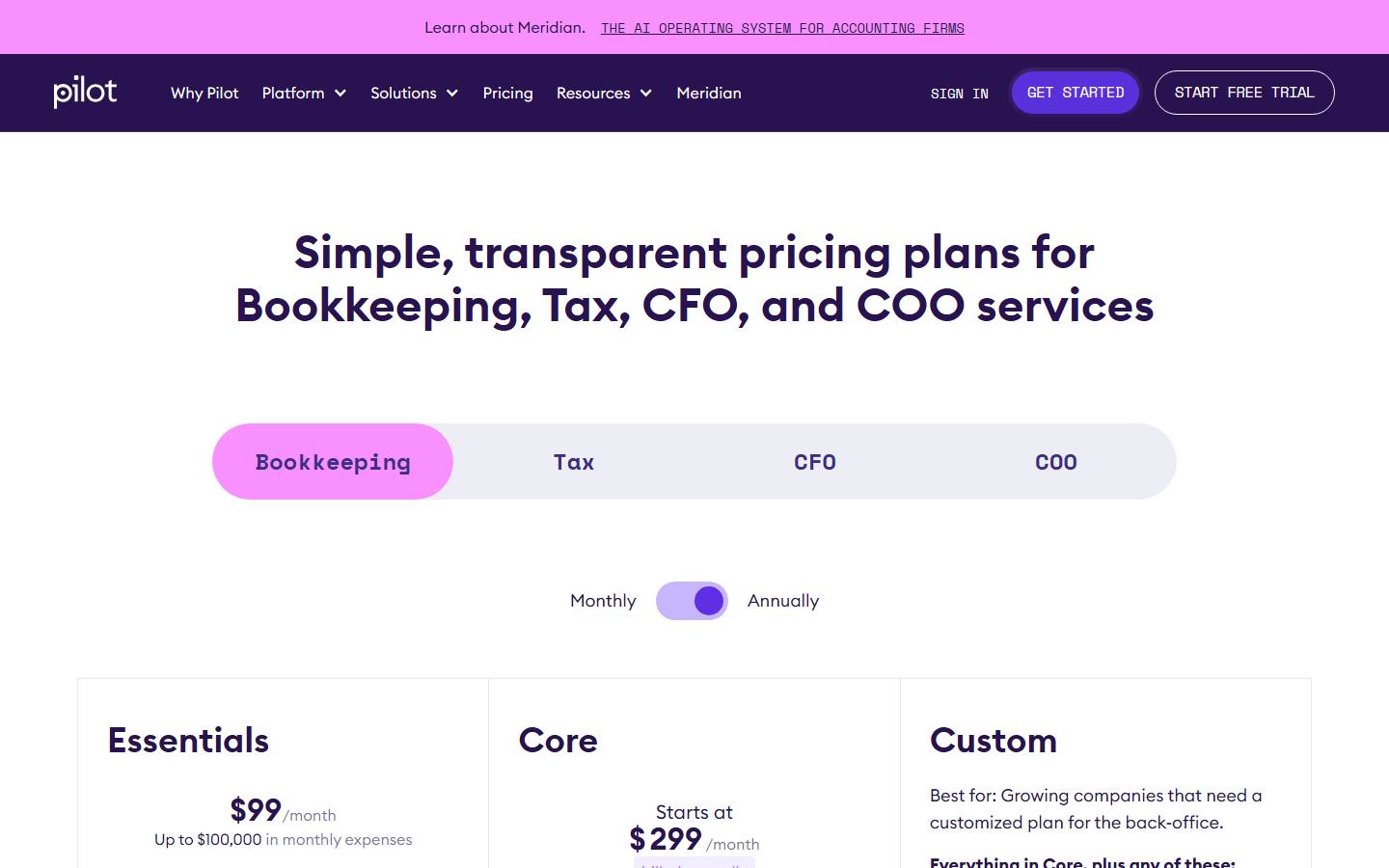
What $99 a month actually buys
Pilot builds cash-basis books from your bank and credit card data. A standard chart of accounts comes with it, along with a year-end package for whoever files your return, which is the bit your tax preparer will thank you for. Instant AI answers about past transactions and current cash flow, with scenario planning on top. Support runs through in-app messaging.
The tier above is Core, and it is where the money changes shape. Core adds a US-based bookkeeper who reviews the books, accrual-basis accounting, bill management for up to 10 vendor bills a month, and reporting on the 10th business day. It starts at $299 a month billed annually, and that figure is tied to the $9,000 of monthly expenses the page's slider opens on. Move the slider and the number moves with it, so read "starts at" literally.
Tax is its own line item. The Single Member LLC service starts at $1,000 a year and up, billed annually. Pilot also markets Meridian to firms, described on its own site as the AI operating system for accounting firms, which tells you something about where the company sees the bigger market.
Pros
- A published price for a finished outcome, which is rare in this category
- AI runs the first pass and, above Essentials, a US-based bookkeeper reviews it
- Year-end package aimed straight at your tax preparer
- Cash flow and transaction questions answered inside the product
Cons
- The $99 tier caps at $100,000 in monthly expenses
- Core's price moves with a slider, so the entry figure only holds at the low end
- Tax is a separate annual fee starting at $1,000 and up
- Essentials is cash-basis, so accrual accounting means moving up
- Best for
- An owner who wants the monthly close to stop being their problem and who spends under $100,000 a month.
- Pricing
- Essentials $99 a month, for up to $100,000 in monthly expenses. Core from $299 a month billed annually, at the $9,000 of monthly expenses the slider opens on. Single Member LLC tax service from $1,000 a year and up, billed annually. Read on pilot.com/pricing on 26 September 2026.
- Free tier
- Not verified on 26 September 2026.
- Verdict
- The only product here that sells a finished month. Price it against what your current bookkeeper charges for the same work.
2. Xero: the ledger that absorbs the dull half
Xero is the opposite purchase. You buy the system of record, and you or the bookkeeper you pay still run it every month.
The US plans, at standard prices, on 26 September 2026: Early at $25 a month, Growing at $55, Established at $90. Early is deliberately small, carrying 20 invoices and 5 bills, and the two plans above it lift both limits.
The AI sits in exactly the places a small business would want it. Auto-reconcile matches bank transactions so nobody ticks them off by hand. Smart Document Capture reads the paperwork so nobody retypes it. Established stacks on the things a growing company starts to need: a 180 day cash flow forecast, multiple currencies, project time and costs, and employee expense claims. If bank matching is the specific hour you want back, invoice reconciliation inside Xero goes through it properly.
The discount on the page, and why it is not in my table
On 26 September 2026 Xero's US pricing page was running 90% off your plan for the first six months if you bought by 30 September 2026. That makes every plan look like a tenth of its real cost. The offer was due to end four days after I read the page and roughly three weeks before this post was published, and it only ever covered six months.
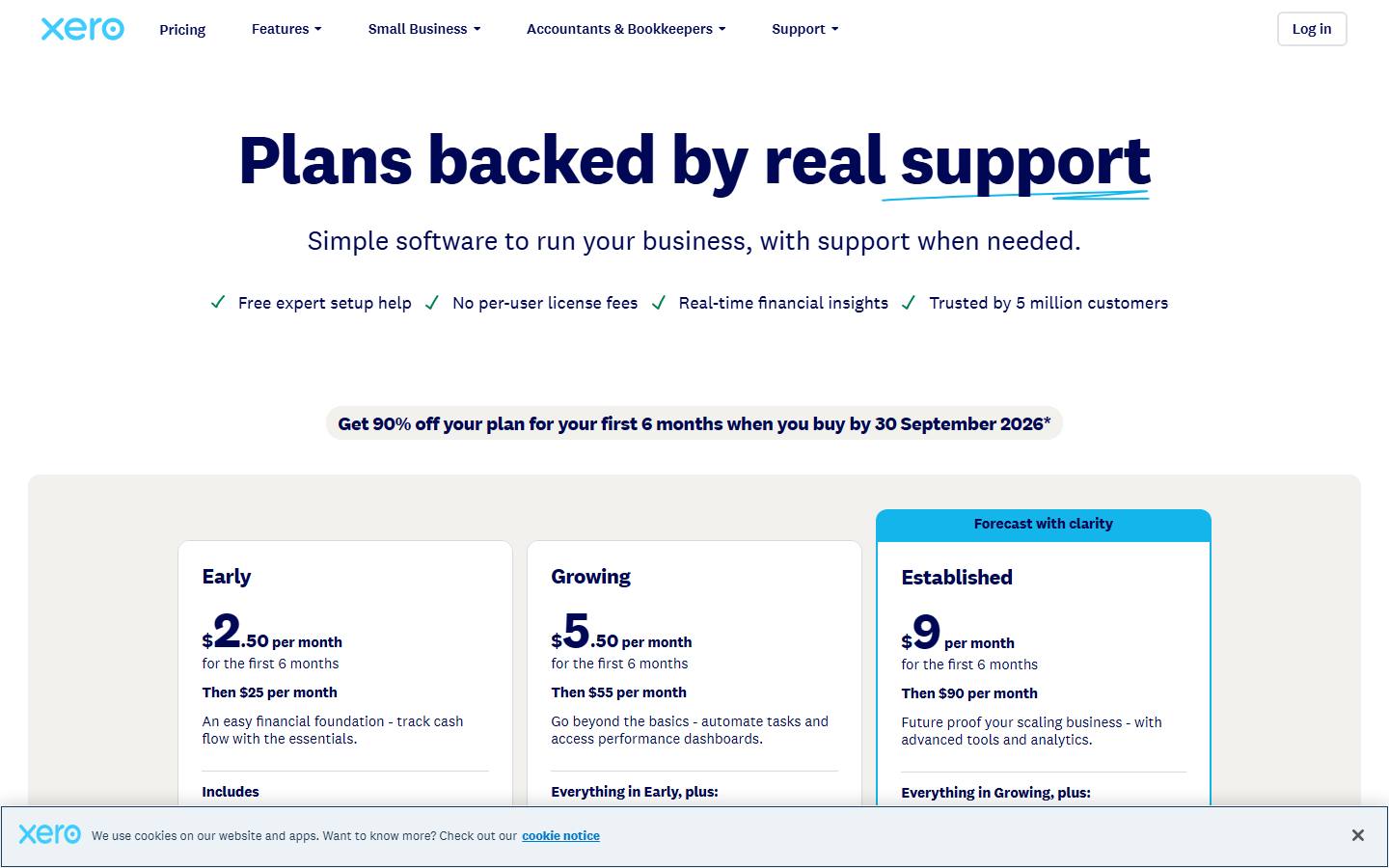
Budget on $25, $55 and $90. If a banner like that is still up when you look, it is six months off a price you already know.
Xero suits the business that already pays somebody to keep the books and wants that person spending fewer of their billable minutes on data entry. It makes the close shorter for whoever owns it, and on 26 September 2026 that cost $25, $55 or $90 a month depending on how many invoices and bills you push through it.
Buying for a firm rather than a business? The practitioner view is a different post: what actually saves bookkeepers time in 2026 covers the workflow side, including categorisation and the month-end chase.
3. Intuit QuickBooks: the AI that has to show its working
Intuit is the incumbent, and in 2026 its answer is a conversation.
On 12 August 2026 the company announced the expansion of Intuit Intelligence across QuickBooks Online Advanced and Intuit Enterprise Suite. The headline capability is Intuit Intelligence Chat, which Intuit describes as a conversational experience that uses a customer's unique business data to deliver personalized insights, recommendations and actions. Intuit calls Enterprise Suite its AI-native ERP and says multi-entity accounting and multi-currency support are expanding with it.
Why Intuit is talking about audit trails
The most useful sentence in that announcement belongs to Ashley Still, EVP and GM of Small Business and Mid-Market at Intuit: "Finance teams need AI they can stand behind when asked how a number was reached." Read it as a product requirement. Somebody will question the number, and a person has to answer for it.
Now the awkward part. I could not verify a QuickBooks price. quickbooks.intuit.com returned HTTP errors when I tried to read it on 26 September 2026 and I did not get a rendered page out of it, so the price cell in my table says unverified and stays that way until I can read the page myself. You can check it in a browser in about thirty seconds, which is thirty seconds more of verification than I can honestly offer. For the task-level view of what the AI touches, the QuickBooks AI agent breakdown and bank reconciliation in QuickBooks both stay on ground I can stand behind.
Pros
- The AI answers from your own business data, which is the point of the chat
- Intuit is naming auditability as the requirement, in public, with a name attached
- Enterprise Suite covers multi-entity accounting and multi-currency
- If your books are already here, there is nothing to migrate
Cons
- I could not read a price on 26 September 2026, so treat every third-party figure with suspicion
- The announcement names Advanced and Enterprise Suite, so check your own plan
- A chat answer is still an answer somebody has to approve
Everything in this section comes from one dated document: Intuit's investor press release of 12 August 2026, listed in the sources below.
4. Gravity: the paperwork around the books, not the books
This is my product, so discount me accordingly. It is last on the page because it is the only thing here that is not an accounting system.
Gravity is not a ledger. It does not file your taxes, it is not your system of record, and comparing it to Pilot or Xero on bookkeeping accuracy would be a category error, and one I would lose anyway.
What it does is the admin wrapped around the books. Chasing the invoice that went quiet. Pulling receipts out of an inbox. Nudging a client for the document they swear they sent. It sorts attachments into the right place before anybody opens the accounting software at all. You describe the task in plain words, an agent that a builder has already made runs it, and the output lands in Xero or QuickBooks. The specific jobs live in their own posts: chasing unpaid invoices, categorising expenses, accounts payable and getting tax documents into one folder.
Where an agent stops and the ledger starts
The handoff is the entire design. An agent can collect, sort, and send the third reminder without anyone remembering to. It should never be the thing that decides your accounts are correct. That decision belongs to whoever signs, which is the same rule the other three products here live by.
What you get: nothing to build or host, chases that run whether or not you remember them, and one predictable monthly price. What you do not get is the close, the trial balance or a filing, and the catalogue of published agents is still short because Gravity is in private alpha.
- Best for
- The owner whose actual complaint is unpaid invoices and missing receipts, with a trial balance that is basically fine.
- Pricing
- First agent free, no card. Then Pro at $5 a month during the alpha, or Max at $20 a month for more agents and usage. Buy more usage from your account if you run out. Gravity pricing, September 2026.
- Free tier
- Yes. One agent, free.
- Verdict
- A companion to a ledger. It takes the chasing off your week, and your accountant still owns the close.
Which one should you choose?
Start with Pilot if you want the books done and you spend under $100,000 a month. Ninety-nine dollars for a closed month is the clearest published price in this comparison.
Choose Xero if you already pay a bookkeeper. You are buying the ledger and the AI that shortens their hours, at $25, $55 or $90 a month.
If your accounts already sit in QuickBooks, the question is whether Intuit Intelligence reaches the plan you are on. The 12 August 2026 announcement names Advanced and Enterprise Suite, and you will have to price it yourself.
Above $100,000 in monthly expenses, every honest answer on this page turns into a sales call. Go in with your transaction volume and your entity count already written down.
When the real pain is that nobody paid you and nobody filed the receipt, an agent is the fix, and receivables follow-up is usually the first one worth running.
Practitioners have a separate shortlist. The accountant stack and the bookkeeper version cover the work inside a firm.
And if the whole decision is really about the monthly number, the cheapest AI agent platforms compares this category on price alone. That page is about agents, so read it after you have picked a ledger.
My bias, stated plainly: I sell the agent, not the ledger, and a business with real bookkeeping needs should buy both.
FAQ
Can an AI agent replace my bookkeeper?
No, and none of the vendors in this comparison claim it can. The AI categorises transactions, reconciles accounts and drafts the close, then a person reviews it and signs off. Pilot's more automated tiers add a US-based bookkeeper who reviews the books, so the automation arrives with a person attached, which is a fair summary of where the category actually sits in 2026.
What does an AI agent for accounting cost?
Pilot's Essentials tier is $99 a month for businesses with up to $100,000 in monthly expenses. Xero's US plans at standard prices are $25 a month for Early, $55 for Growing and $90 for Established. I could not verify a QuickBooks price on 26 September 2026, so this post does not quote one.
What do you get for Pilot's $99 a month?
Cash-basis bookkeeping built from your bank and credit card data, a standard chart of accounts, a year-end package for your tax preparer, instant AI answers about past transactions and current cash flow with scenario planning, and support through in-app messaging. Pilot's own summary line for the tier is that AI categorizes transactions, reconciles accounts, and closes books monthly. The tier is capped at $100,000 in monthly expenses.
Does QuickBooks have an AI agent?
Intuit announced the expansion of Intuit Intelligence across QuickBooks Online Advanced and Intuit Enterprise Suite on 12 August 2026. The headline capability is Intuit Intelligence Chat, which Intuit describes as a conversational experience that uses a customer's unique business data to deliver personalized insights, recommendations and actions. Check your own plan before you assume it is included, because the announcement names Advanced and Enterprise Suite.
Does Xero have AI built in?
Yes, in two places that matter to a small business: auto-reconcile for bank transactions and Smart Document Capture for paperwork. Both hand you a suggestion you accept or correct. The Established plan at $90 a month also carries a 180 day cash flow forecast, multiple currencies, project time and costs, and employee expense claims.
Can AI file my taxes?
None of the plans in this comparison include a filed return. Pilot sells tax as a separate service, with the Single Member LLC package starting at $1,000 a year and up, billed annually. An agent can get every document into one place before your preparer opens the folder, which is usually the part that runs late.
What is the difference between accounting software and an AI agent for accounting?
Accounting software is your system of record, and the AI inside it suggests categories and matches for you to approve. An AI agent is a worker that runs one task end to end and hands the output somewhere else, which is why Gravity sits beside a ledger and feeds it. If your real complaint is unpaid invoices and receipts nobody filed, the agent is the cheaper fix.
Should I pick Pilot or Xero?
Pick Pilot if you want the monthly close off your desk and you spend under $100,000 a month, because $99 buys a finished month. Pick Xero if you already pay a bookkeeper and want the ledger to absorb more of the typing, at $25, $55 or $90 a month. Above Pilot's expense cap, its next tier is a Contact Sales button with no published price.
Sources
- Pilot pricing, read 26 September 2026.
- Xero US pricing plans, read 26 September 2026. Standard plan prices quoted, not the promotional rate that was due to end 30 September 2026.
- Intuit, "Intuit Advances Its Mid-Market Platform With Conversational AI, Enterprise Scale, and Deep Industry Workflows for CFOs and Accounting Firms", investor press release, 12 August 2026.
- Gravity pricing, September 2026.
- QuickBooks pricing: not verified. quickbooks.intuit.com returned HTTP errors on 26 September 2026 and no price is quoted in this post.