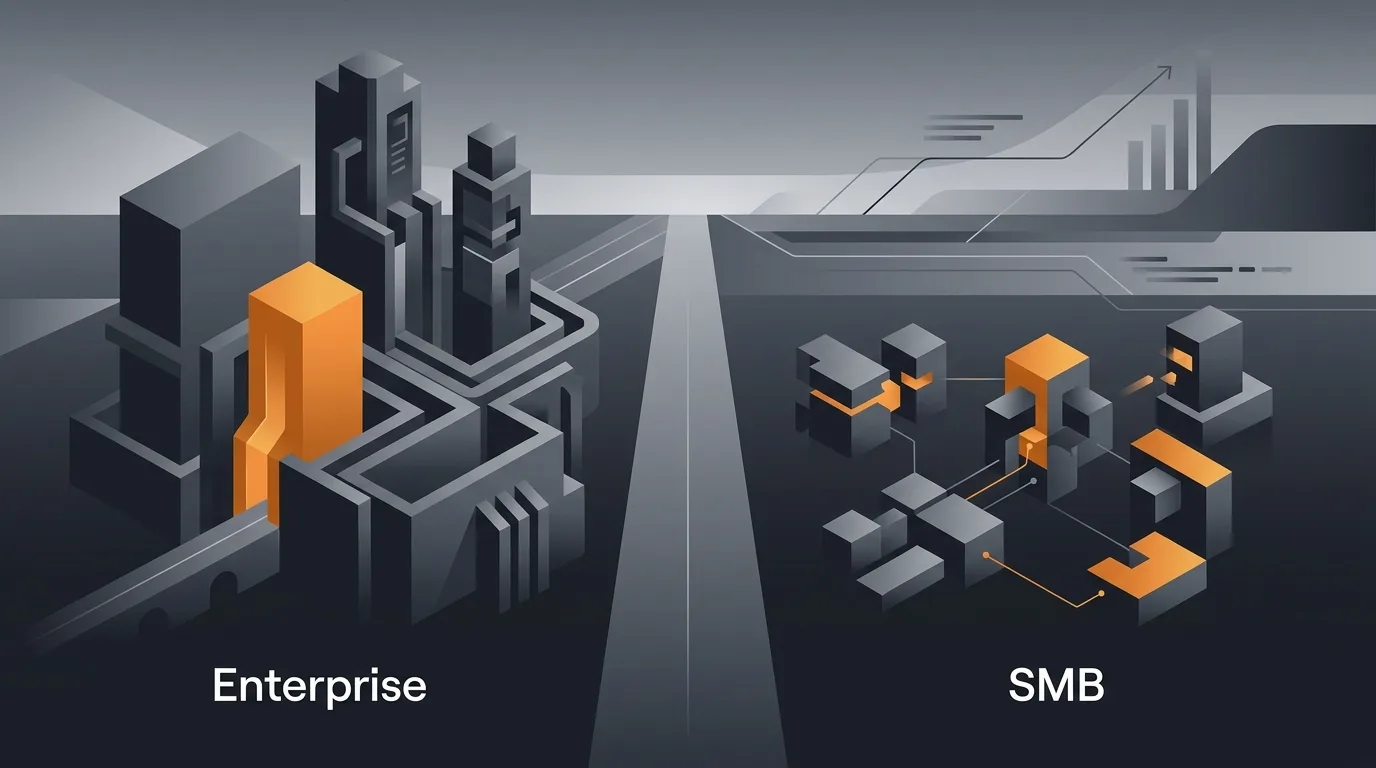
By 2026, AI agents are no longer a question of whether but of how, and the how looks very different depending on the size of the buyer. A 40,000-person enterprise and a 12-person agency both want agents to do real work, but they arrive at that decision from opposite directions, hit different walls, and measure success against different benchmarks. Treating "AI agent adoption" as one trend hides the most useful part of the story, which is the split between the two.
This piece breaks that split down honestly: the drivers that pull each segment in, the blockers that hold each back, the use cases that lead in each, and the budget and buying differences that shape everything else. The numbers in this space move fast and are often unconfirmed, so we keep the comparison qualitative on purpose, larger versus smaller, faster versus slower, rather than leaning on precise figures that go stale. The aim is a map you can place yourself on, whether you sit in a procurement committee or you are the founder doing three jobs at once.
Two adoption profiles
Start with the shape of each buyer, because everything else follows from it. An enterprise has people, process, and existing systems in abundance. It is rarely short on headcount in absolute terms; it is short on leverage, consistency, and the ability to grow output without growing cost in lockstep. So an enterprise looks at an agent and asks whether it can safely scale a workflow across many teams, regions, and compliance regimes without introducing new risk.
An SMB is the mirror image. It is short on people and specialist skills, and it cannot justify a full hire for many of the jobs that nonetheless need doing. A small business looks at an agent and asks whether it can get marketing, support, research, or analysis done at all, at a price it can absorb this month. For the enterprise, an agent is an optimization. For the SMB, an agent is closer to a hire it could not otherwise make. If you are still mapping the basic concept, our explainer on what an AI agent is sets the foundation this comparison builds on.
What drives each segment
The driver gap is the root of almost every other difference. Enterprises are pulled in by capacity and consistency. They want to absorb higher volume without a one-to-one increase in headcount, standardize the quality of an output across many people and locations, and free expensive specialists from repetitive work so they spend time on judgment-heavy tasks. Cost matters, but it is rarely the headline; the headline is leverage. A maintained agent that handles a workflow the same way every time can be more consistent than a large, stretched team, and that reliability is itself a driver.
SMBs are pulled in by access and survival economics. The driver is not "do this slightly cheaper" but "do this at all." A small team rarely has a dedicated analyst, a designer on staff, or a support specialist, so an agent that performs that role expands what the business can do rather than trimming what it already does. Speed and low upfront cost matter far more here than to an enterprise, because an SMB is comparing the agent to going without, not to a department. That is why broad, generalist help resonates with smaller teams; our overview of AI agents for every profession reflects how widely that pull spreads across roles.
What blocks each segment
If the drivers explain why each segment buys, the blockers explain why one moves slowly and the other moves fast. Enterprise blockers are about process and risk control. Before an agent touches production, it typically passes governance review, data security and privacy assessment, integration work against legacy systems, and a procurement cycle with multiple approvers. None of this is irrational; it is how a large, regulated organization protects itself. But it adds months, and it means the best technical fit can still lose to the option that clears review most cleanly.
SMB blockers are about resources and know-how. The constraints are a limited budget that cannot absorb a large commitment before value is proven, no in-house AI or data skills to configure and maintain a tool, and genuine uncertainty about which option to trust in a crowded market. An SMB will not run a six-month procurement, but it also cannot afford a tool that needs a data engineer to operate. So the winning option for an SMB is not the most powerful; it is the one that is cheap to start and works without specialist setup. Both segments benefit from a disciplined selection process, which is why we wrote a buyer's framework for how to evaluate AI agent platforms that works at either scale.
Leading use cases
There is real overlap in what each segment automates, but the emphasis diverges. Customer support, content and marketing, and back-office automation appear on both lists. The difference is in what each is optimizing for.
Enterprises tend to lead with high-volume, regulated, or cross-system workflows: support at a scale where consistency and audit trails are non-negotiable, document and data processing across many systems, and internal operations where a standardized output reduces variance and risk. The value is in handling volume reliably and provably. For the support category specifically, our roundup of the best AI agents for customer support covers how that plays out in practice.
SMBs tend to lead with generalist help that substitutes for roles they cannot hire: marketing and content production, customer support for a small queue, research and competitive analysis, and administrative work that otherwise eats the founder's week. The same category, support, serves a different purpose: for the enterprise it is scale and compliance, for the SMB it is simply covering a function with no dedicated owner. Reading the use-case lists side by side, the pattern is consistent: enterprises automate to standardize, SMBs automate to exist in more places at once.
Budgets and buying process
The money tells the same story from a different angle. Enterprises bring larger budgets through a longer process. Spend is committed in bigger increments, often as annual contracts, and the decision passes through a buying committee that includes the function owner, security, legal, procurement, and finance. Time-to-value is measured in quarters, and the organization expects formal pilots, references, and security documentation before scaling. The budget is large, but it is slow and conditional.
SMBs bring smaller budgets through a faster process. The decision often sits with one or two people, frequently the owner, and spend starts small and grows with usage rather than committing up front. Time-to-value is measured in days, and the bar is "does this clearly help this month." That speed is an advantage for adoption but a disadvantage for diligence: with no security team or procurement function, the SMB leans on the platform to handle reliability and trust on its behalf. This is exactly where the build-versus-buy question gets decided, and we work through it axis by axis in build vs buy an AI agent. For most SMBs, build is off the table on cost and skills alone, which pushes the decision toward managed, buy-side options.
Enterprise vs SMB at a glance
A side-by-side summary of the two adoption profiles. Comparisons are qualitative by design.
| Dimension | Enterprise | SMB |
|---|---|---|
| Primary driver | Capacity and consistency at scale | Access to work it cannot afford to hire for |
| Top use cases | High-volume support, cross-system processing, regulated workflows | Marketing, support, research, admin: generalist help |
| Main blocker | Governance, security review, procurement | Budget and in-house skills |
| Budget model | Larger, committed up front, often annual | Smaller, starts low, grows with usage |
| Buying process | Committee: function, security, legal, finance | One or two people, often the owner |
| Time-to-value | Quarters; pilots and sign-offs first | Days; clear help this month |
| Build vs buy | Both on the table; weighs compliance and control | Buy, almost always; build is off the table on cost and skills |
Which pattern are you
The practical use of this map is to locate yourself, because the right adoption playbook follows from the profile, not from the technology. If you recognize the enterprise pattern, your work is mostly de-risking: get security and procurement involved early, scope a pilot with a measurable outcome, and choose on whether the option clears your governance bar as much as on its feature list. Your budget can carry a heavier tool, so the constraint is trust and integration, not money.
If you recognize the SMB pattern, your work is mostly removing friction: find an option you can start cheaply, that works without specialist setup, and that proves value fast enough to justify the next dollar. Your constraint is the opposite, money and skills rather than process, so the winning option is the one that lets you experiment without a project. This is precisely where a managed model with a free entry point changes the math. When a platform runs and maintains the agent and a free tier lets you prove value before spending anything, the two biggest SMB blockers, upfront cost and required skills, both fall away at once, and adoption becomes a quick test rather than a commitment.
That is the model Gravity is built around. You describe an outcome in plain words, an expert-built agent runs it and hands back the finished result in about 60 seconds, and pricing starts with a free tier that covers one agent, with paid plans from $20 a month with a lot of usage included. There is no large upfront contract, no data team required, and no stack to assemble or maintain, because Gravity carries the execution and the reliability. For a smaller business, that turns AI agent adoption from a budget-and-skills problem into something you can try this week; for an enterprise, the same managed reliability is what makes a workflow safe to scale.
Frequently asked questions
How is AI agent adoption different for enterprise versus SMB in 2026?
The motive and the friction differ. Enterprises adopt to add capacity and standardize quality across large teams, and their main friction is governance, security review, and procurement. Small and mid-sized businesses adopt to do work they cannot afford to hire for, and their main friction is budget and in-house skills. So enterprises move slowly through committees on large budgets, while SMBs move fast on small budgets once a tool is cheap and easy to start.
What drives enterprises to adopt AI agents?
Enterprises are driven mostly by capacity and consistency rather than headline cost. They want to handle higher volume without a linear increase in headcount, standardize quality across many people and locations, and free expensive specialists from repetitive work. Risk reduction matters too: a maintained, auditable agent can be more consistent than a stretched team. The driver is leverage at scale, not survival.
What drives small businesses to adopt AI agents?
For SMBs the driver is access to work they otherwise could not staff. A small team rarely has a dedicated analyst, designer, or support specialist, so an agent that does that job is closer to hiring than to optimizing. The pull is capability and speed at a price a small budget can absorb, which is why low upfront cost and a fast time-to-value matter far more to an SMB than to an enterprise.
What are the biggest blockers to AI agent adoption?
They differ by segment. For enterprises the blockers are governance, data security and privacy review, integration with legacy systems, and a long procurement and approval process. For SMBs the blockers are limited budget, no in-house AI or data skills, and uncertainty about which tool to trust. Enterprises are slowed by process and risk control; SMBs are slowed by resources and know-how.
Do enterprises and SMBs use AI agents for the same tasks?
There is overlap but the emphasis differs. Customer support, content and marketing, and back-office automation appear on both lists. Enterprises lean toward high-volume, regulated, or cross-system workflows where consistency and audit trails matter. SMBs lean toward broad, generalist help that substitutes for roles they cannot hire, such as marketing, support, research, and admin. The same category often serves a different purpose in each.
Why are managed platforms with free tiers easier for SMBs to adopt?
Because they remove the two biggest SMB blockers at once: upfront cost and required skills. A managed platform runs and maintains the agent, so a small team does not need data engineers or a long setup. A free tier means no large commitment before value is proven, and paid plans from $20/month include usage, so the cost is known before you scale. That lowers the barrier from a project to a quick experiment, which fits how SMBs actually buy.
The short version
- Same technology, opposite starting points. Enterprises adopt for leverage at scale; SMBs adopt for access to work they cannot hire for.
- The blockers decide the pace. Governance and procurement slow enterprises; budget and skills slow SMBs.
- Place yourself, then pick the playbook. Enterprises de-risk and integrate; SMBs remove friction, and managed platforms with free tiers are what make that possible.